
BWSENSING Cost-Effective Dual-Axis Digital Output With Modbus Inclinometer (BWN427)
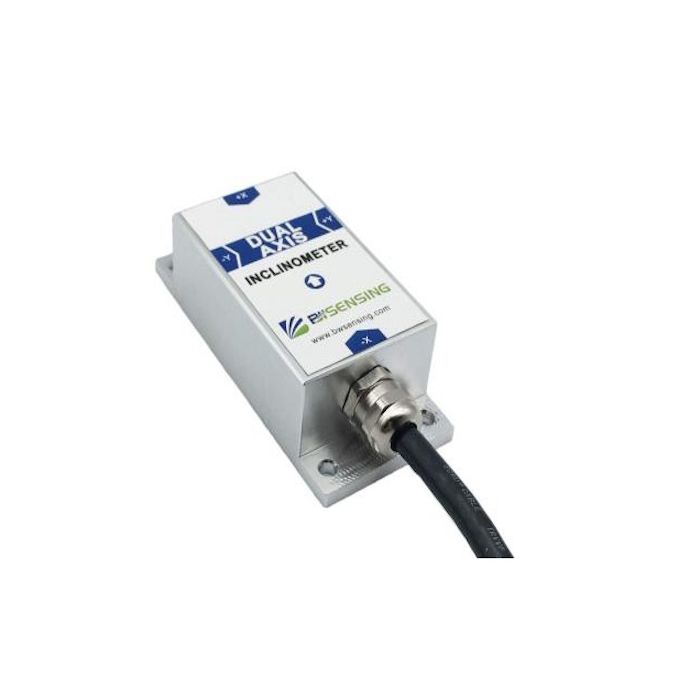
In stock
- BRAND:
- BWSENSING
- PART #:
- BWN427
- ORIGIN:
- China
- AVAILABILITY:
- SUBJECT TO AVAILABILITY
- SKU:
- BWSENSING-BWN427
BWSENSING Cost-Effective Dual-Axis Digital Output With Modbus Inclinometer (BWN427)
According to the manufacturer’s technical documentation, the BWN427 uses MEMS sensing technology and provides Modbus output, with a ±90° measurement range, resolution of 0.01°, and maximum stated accuracy of 0.02° (under specified conditions).
In practical deployments, dual-axis inclinometers like the BWN427 are used to quantify slow tilt and static angular changes in assets such as towers, platforms, mechanical arms, and structural elements—especially where continuous monitoring and straightforward field wiring are required.
Design and Features
The BWN427 is described as a rugged sensor for long-term, real-world use. It is offered with multiple serial interface options—RS232, RS485, or TTL—and packaged to support outdoor or industrial environments with an IP67 protection level.
Mechanical design
The unit is specified with a compact metal enclosure and standardized mounting approach:
-
Dimensions: L90 × W40.5 × H26 mm
-
Protection level: IP67
-
Installation method: Four M4 screws (as listed in the mechanical index)
Core functional features
Key feature highlights in the manual include:
-
Dual-axis inclination measurement
-
Resolution: 0.01° (in fully still conditions)
-
Range: ±90°
-
Highest stated accuracy: 0.02°
-
Digital communications: Modbus with RS232/RS485/TTL optional output modes
Technology and Specifications
Measurement principle
The BWN427’s technical manual describes a sensor architecture based on a high-precision MEMS accelerometer with conversion and processing components, including automatic compensation and filtering algorithms intended to reduce environmental error effects (e.g., temperature drift and changing conditions).
In typical inclinometer operation, the sensor estimates tilt by observing the direction of the gravity vector and converting changes in that vector into angular measurements for each axis.
Electrical and environmental specifications
The manufacturer lists the following core operating characteristics:
-
Power supply: 9–36 VDC
-
Working current (no load): 20–40 mA (typical values provided)
-
Operating temperature: –40°C to +85°C
-
Storage temperature: –55°C to +100°C
Performance specifications
The BWN427 is specified for static and low-dynamic tilt monitoring, with listed performance indices including:
-
Measurement range: ±90°
-
Axes: X–Y
-
Accuracy: 0.02° (highest)
-
Resolution: 0.01° (fully still)
-
Output frequency: 5–100 Hz adjustable, up to 100 Hz
-
Zero bias: ±0.005°/°C (over –40 to 85°C)
-
Cross-axis error: 0.01° (over –40 to 85°C)
-
MTBF: ≥ 90,000 hours
Communications and wiring
The technical manual indicates RS485 and RS232 wiring schemes and lists RS232/RS485/TTL as optional output modes.
In many industrial settings, RS485 + Modbus RTU is favored for multi-drop networks and long cable runs, while RS232 is commonly used for short point-to-point connections and bench configuration.
Applications and Use Cases
The BWN427 is presented as suitable for both monitoring and control applications. The manufacturer’s application list includes:
-
Industrial automatic leveling
-
Photovoltaic automatic tracking
-
Tower tilt monitoring
-
Lifting equipment inclination control
-
Structural deformation monitoring
-
Surveying and mapping instruments
-
Medical instruments
In operational terms, these applications typically fall into two broad categories:
-
Condition monitoring: detecting slow changes in tilt that may indicate settlement, deformation, or stability risks (e.g., poles, towers, retaining structures).
-
Control and automation: providing tilt feedback to keep platforms level, align equipment, or maintain tracking angles (e.g., solar trackers and leveling systems).
Advantages / Benefits
Common advantages associated with the BWN427’s stated design and specifications include:
-
Wide dual-axis range (±90°): supports installations where orientation may vary significantly.
-
Fine resolution (0.01°): useful for detecting subtle tilt changes in stable conditions.
-
Industrial environmental tolerance: operating range down to –40°C and up to +85°C supports outdoor and heavy-duty deployments.
-
Flexible serial interfaces: RS485/RS232/TTL options allow adaptation to different controllers, gateways, and test tools.
-
IP67 enclosure rating: intended to reduce dust ingress and withstand water exposure during field use.
FAQ Section
What is the BWSENSING BWN427 inclinometer?
The BWSENSING BWN427 is a cost-effective dual-axis inclinometer that measures tilt on two axes over a ±90° range and provides Modbus output, with stated 0.01° resolution and up to 0.02° highest accuracy.
How does the BWN427 work?
The BWN427 uses a MEMS accelerometer-based sensing approach to detect changes in the gravity vector and convert them into X- and Y-axis tilt angles. The device applies internal compensation and filtering algorithms intended to reduce environmental error effects.
Why is a dual-axis Modbus inclinometer important?
A dual-axis Modbus inclinometer helps systems measure both pitch and roll in a single sensor, while Modbus (commonly used in industrial automation) simplifies integration with PLCs, RTUs, and SCADA systems—especially where RS485 networks are standard.
What are the benefits of the BWN427?
Benefits described in the manufacturer documentation include dual-axis measurement, 0.01° resolution, a ±90° range, IP67 protection, 9–36V power, multiple serial output options, and suitability for applications like tower tilt monitoring and industrial leveling.
Summary
The BWSENSING BWN427 is an industrial dual-axis Modbus inclinometer built around MEMS sensing, offering a ±90° range, 0.01° resolution, and a stated 0.02° highest accuracy, with IP67 protection and 9–36V operation for field and automation deployments.
Specifications
| PART # | BWN427 |
|---|---|
| BRAND | BWSENSING |