
BWSENSING Modbus Dual Axis Inclinometer (BWH527)
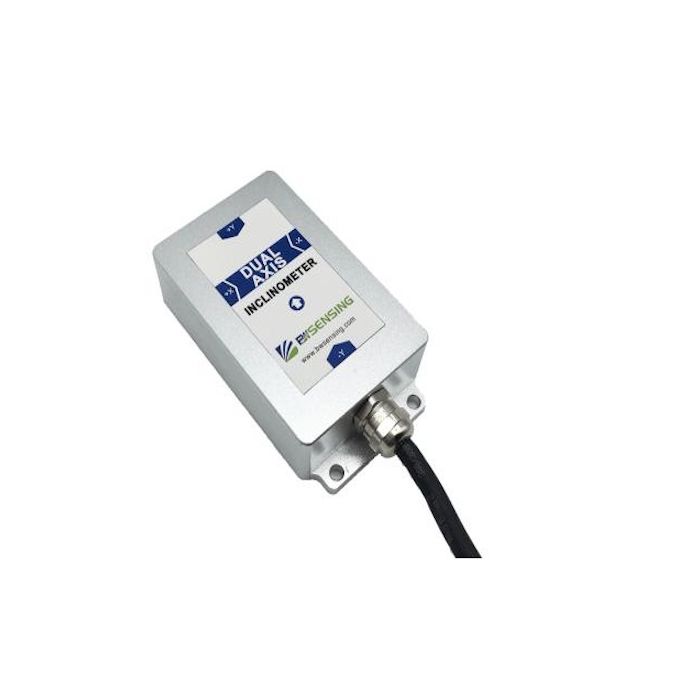
In stock
- BRAND:
- BWSENSING
- PART #:
- BWH527
- ORIGIN:
- China
- AVAILABILITY:
- SUBJECT TO AVAILABILITY
- SKU:
- BWSENSING-BWH527
BWSENSING Modbus Dual Axis Inclinometer (BWH527)
Inclinometers (also called tilt sensors) are widely used in civil engineering, energy infrastructure, automation, and mobile machinery to detect angular changes that may indicate deformation, settlement, misalignment, or unsafe operating conditions. The BWH527 is intended for these environments by combining high resolution, environmental protection, and serial configurability in a compact industrial housing.
Design and Features
Industrial enclosure and installation
The BWH527 is built for field deployment, with an IP67-rated enclosure (water and dust protection, subject to proper sealing practices) and a mechanical mounting approach based on three M4 screws. The housing material is described as a magnesium–aluminum alloy with an oxidized finish, intended to balance strength, corrosion resistance, and weight.
A typical configuration includes a metal connector and ~1.5 m cable, supporting industrial wiring practices for power and serial communications. The published package size is approximately L103.8 × W55.4 × H26 mm.
Digital output options and configurability
BWH527 variants support multiple serial interfaces—RS-485, RS-232, and TTL—with baud rates adjustable from 2400 to 115200 and an output frequency adjustable from 5 to 100 Hz, enabling integration with PLCs, data loggers, and embedded controllers.
The model family is commonly presented with interface-specific part variants such as BWH527-30-485, BWH527-30-232, and BWH527-30-TTL, reflecting the same measurement platform with different communication layers.
Technology and Specifications
Measurement principle (MEMS tilt sensing)
The BWH527 uses MEMS sensing to infer inclination by measuring the direction of the static gravity field and converting that into angle outputs. This approach is widely used in modern inclinometers because it is compact and can be ruggedized for industrial operation. The BWH527 documentation describes a non-contact measurement principle, with internal compensation and filtering algorithms to reduce error due to environmental changes.
Core specifications (typical published values)
The manufacturer’s technical manual lists the following key performance and environmental specifications:
-
Measurement range: ±30° (dual axis X–Y)
-
Highest accuracy: up to 0.003° (with typical values also listed in the manual)
-
Resolution: 0.0007° (under still conditions)
-
Input voltage: 9–36 V wide-voltage input
-
Operating temperature: −40 °C to +85 °C
-
Start-up time: < 3 s
-
Protection rating: IP67 (with sealing guidance noted)
-
Impact resistance: 2000 g, 0.5 ms, 3 times/axis
-
MTBF: ≥ 90,000 hours
Electrical interface overview
For RS-485 implementations, the manual provides typical wiring guidance with DC power input and differential data lines (often labeled A/B or D+/D− depending on system conventions). It also indicates that parameters such as baud rate and output frequency are configurable, which can be important when matching a Modbus RTU network’s timing and polling design.
Applications and Use Cases
The BWH527 is presented for a range of monitoring and control scenarios where dual-axis tilt provides actionable information:
Structural and infrastructure monitoring
-
Wind tower tilt monitoring to detect foundation movement, tower deformation, or installation alignment issues
-
Bridge and dam monitoring where long-term inclination trends can indicate settlement or structural behavior changes
Surveying, mapping, and precision leveling
-
Exploration surveying and mapping equipment and railroad gauge ruler leveling, where consistent angle reference supports measurement quality
-
High-precision platform leveling in labs, industrial metrology, or equipment alignment tasks
Industrial automation and mobile machinery
-
Industrial automation attitude control in fixtures, platforms, or automated systems that require tilt compensation
-
Construction machinery inclination measurement and lifting equipment inclination control, where tilt feedback can support safety logic and operational limits
Advantages / Benefits
High resolution for small-angle changes
A published resolution of 0.0007° targets applications where small changes matter, such as slow structural drift or precision leveling tasks.
Wide-voltage and wide-temperature operation
Support for 9–36 V input and −40 to +85 °C operation simplifies deployment across industrial power systems and outdoor environments, particularly in energy and infrastructure use cases.
Ruggedization and environmental sealing
The combination of IP67 protection and a metal enclosure design is aimed at field installations where dust, rain, washdown, vibration, and incidental impacts are concerns.
Integration-friendly serial communications
By offering RS-485/RS-232/TTL variants with adjustable baud rate and output frequency, the BWH527 is designed to slot into common industrial stacks (PLC + SCADA, dataloggers, embedded gateways, and Modbus networks).
FAQ Section
What is the BWSENSING BWH527?
The BWSENSING BWH527 is a MEMS-based dual-axis inclinometer that measures tilt relative to gravity over a ±30° range and provides digital outputs commonly used in Modbus/serial industrial integrations.
How does the BWH527 inclinometer work?
It measures changes in the static gravity field using MEMS sensing and converts those measurements into X–Y tilt angles. The documentation describes internal compensation and filtering algorithms designed to reduce environmental error sources.
Why is a Modbus dual-axis inclinometer important?
A Modbus/RS-485 inclinometer can be integrated into PLC and SCADA systems using standardized polling and multi-drop wiring, while dual-axis measurement captures tilt in two directions—useful for structural monitoring, platform leveling, and machinery safety control.
What are the benefits of the BWH527?
Key published benefits include high accuracy (up to 0.003°), high resolution (0.0007°), wide-voltage 9–36 V input, −40 to +85 °C operating range, and an IP67-rated enclosure intended for industrial environments.
What applications is the BWH527 used for?
The manufacturer lists applications such as wind tower tilt monitoring, bridge and dam monitoring, industrial automation attitude control, lifting equipment inclination control, and construction machinery inclination measurement.
Summary
The BWSENSING BWH527 Modbus Dual-Axis Inclinometer is an industrial tilt sensor built around MEMS measurement, emphasizing ±30° dual-axis monitoring, high precision (up to 0.003°), fine resolution (0.0007°), and integration-ready serial connectivity (including RS-485/Modbus-oriented deployments). With rugged environmental protection and configurable communication parameters, it is positioned for structural monitoring, precision leveling, and automation control in demanding field and industrial settings.
Specifications
| PART # | BWH527 |
|---|---|
| BRAND | BWSENSING |