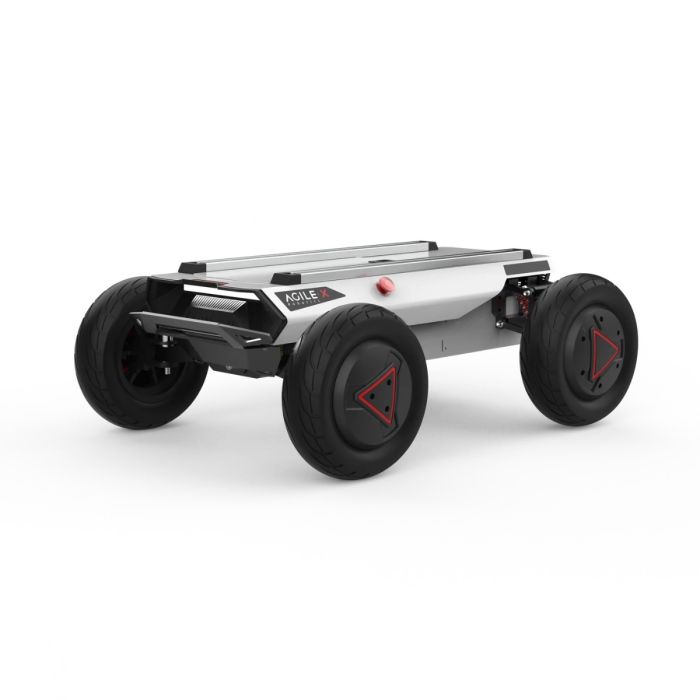
Agilex HUNTER SE (HUNTER SE)
In stock
- BRAND:
- AGILEX
- PART #:
- HUNTER SE
- ORIGIN:
- China
- AVAILABILITY:
- SUBJECT TO AVAILABILITY
- SKU:
- AgileX-HUNTER-SE
Agilex HUNTER SE (HUNTER SE)
Agilex HUNTER SE (HUNTER SE)
HUNTER SE is commonly positioned as a “drive-by-wire” style mobile base for projects such as autonomous parcel delivery, unmanned logistics, and campus or facility patrol scenarios, where predictable steering geometry and road-capable tires can simplify motion modeling and navigation development compared with skid-steer platforms.
Design and Features
Ackermann steering and car-like handling
HUNTER SE uses front-wheel Ackermann steering, a geometry widely used in automobiles to reduce tire scrub and improve turning behavior on paved surfaces. The manufacturer emphasizes the “car-like structure” and steering approach as a key reason the platform can support high-speed autonomous scenarios with reduced tire wear relative to some differential-drive designs.
Chassis construction and modular expansion
AgileX describes the HUNTER SE as inheriting the HUNTER series’ all-steel body and adopting a modular layout intended for add-on kits and sensor payloads. The product page also highlights aluminum T-slot rails for mounting external sensors (e.g., LiDAR, cameras, GNSS, antennas) and accessories, supporting rapid prototyping and reconfiguration.
Drive system and suspension
The user manual describes a DC brushless powertrain and suspension architecture with front non-independent suspension and rear independent suspension. This design aims to balance steering stability with improved ride compliance over uneven surfaces, supporting mixed indoor–outdoor testing.
Technology and Specifications
Platform dimensions, weight, and payload
The HUNTER SE user manual lists dimensions of 820 × 640 × 310 mm, a curb weight of 42 kg, and the manufacturer product page highlights a 50 kg payload rating.
A reseller listing mirrors the same overall size class and payload target, indicating broad consistency on form factor and load category in published materials.
Battery and endurance
Battery configurations described in the manual include 24V lithium packs (noted as 24V 30Ah / 15Ah options), with a listed maximum travel of 20 km (24V 30Ah) or 10 km (24V 15Ah) under stated conditions, and charging time figures around 3 hours for the 30Ah pack.
The official product page presents a simpler headline endurance figure of 120 minutes runtime, which is typical of marketing summaries that assume a representative load and duty cycle.
Speed, mobility, and terrain capability
The manufacturer product page highlights a top speed of 4.8 m/s and frames the platform as suitable for higher-speed autonomous applications in urban road conditions.
However, the user manual’s specification table lists “Maximum speed (km/h) 4.8,” which conflicts with the 4.8 m/s headline shown elsewhere. This discrepancy suggests that published figures may vary by product revision, firmware configuration, test methodology, or unit labeling; in practice, integrators typically confirm the speed limit and safety configuration for the specific unit being deployed.
For clearance and drivability, the manual lists 120 mm ground clearance and a maximum gradeability of full load ≤ 20°, while reseller materials sometimes express climb limits differently (for example, percent-grade values) depending on how the spec is presented.
Obstacle clearance values are commonly cited around 50 mm in reseller technical summaries.
Interfaces and secondary development
HUNTER SE is presented as a developer platform with CAN bus support and secondary development resources. The official product page explicitly mentions CAN bus protocol, an open-source SDK, and software resources; the user manual also references CAN-based development and optional RC transmitter control for testing and manual operation.
Applications and Use Cases
Autonomous delivery and logistics prototyping
Because it pairs road-style steering with a compact chassis and meaningful payload, HUNTER SE is frequently associated with autonomous parcel delivery and unmanned logistics pilots, where the platform may serve as a base for autonomy stacks (perception, planning, control) plus cargo modules.
Research and education in autonomous driving
Universities and R&D teams use Ackermann platforms to validate:
-
motion models closer to passenger vehicles,
-
lane-following and waypoint navigation behaviors,
-
sensor fusion for GNSS/IMU/vision,
-
safety behaviors such as emergency stop and controlled-speed operation.
The HUNTER SE user manual highlights safety guidance and operational modes aligned with development and training environments.
Patrol and inspection in managed environments
The platform is also marketed for patrolling and “touring” style applications (e.g., parks, campuses, industrial estates), where repeatable steering and stable high-speed cruising can be useful—especially when paired with cameras, thermal sensors, or environmental monitors.
Advantages / Benefits
Predictable road-capable steering geometry
Ackermann steering can simplify control and trajectory tracking on paved surfaces, making it attractive for developers building navigation stacks that resemble autonomous vehicle workflows.
Modular expansion for sensors and payloads
The combination of payload rating, rails for mounting, and CAN-based integration supports iterative builds—moving from manual teleoperation to autonomy as sensor suites and compute modules are added.
Compact UGV format for mixed indoor–outdoor testing
At roughly sub-meter length, the platform is easier to transport and test than full-size autonomous vehicle prototypes, while still being capable of outdoor road trials under controlled conditions.
FAQ Section
What is the AgileX HUNTER SE?
AgileX HUNTER SE is a compact Ackermann-steering wheeled UGV designed for urban-road research and autonomous applications, offering car-like driving behavior and modular expansion for sensors and payloads.
How does HUNTER SE work?
HUNTER SE operates as a powered mobile chassis with steering and drive control, typically integrating external compute and sensors. It supports CAN bus connectivity and is described as providing SDK/software resources for secondary development and autonomy integration.
Why is HUNTER SE important?
HUNTER SE is useful because it provides an Ackermann UGV base that can approximate vehicle-like dynamics for robotics teams, enabling experimentation in navigation, perception, and higher-speed control without building a chassis from scratch.
What are the benefits of HUNTER SE?
Key benefits include Ackermann steering for road-like handling, a 50 kg payload class, modular mounting (including T-slot rails), and CAN-based integration intended for secondary development and autonomy projects.
Summary
The AgileX HUNTER SE is a compact Ackermann-steering UGV intended for urban-road robotics, combining car-like handling, modular expansion, and CAN-based development support. With published specifications that emphasize a 50 kg payload class, developer-oriented integration, and a high-speed positioning for autonomous scenarios, it is widely used as a practical platform for research, prototyping, and commercial pilots in autonomous delivery, logistics, and patrolling applications.