Early public messaging placed Martian on the company’s roadmap after the rollout of wheeled models, with trade-press coverage noting plans for market launch following showcase events and pilot deployments.
Design and Features
Humanoid form factor
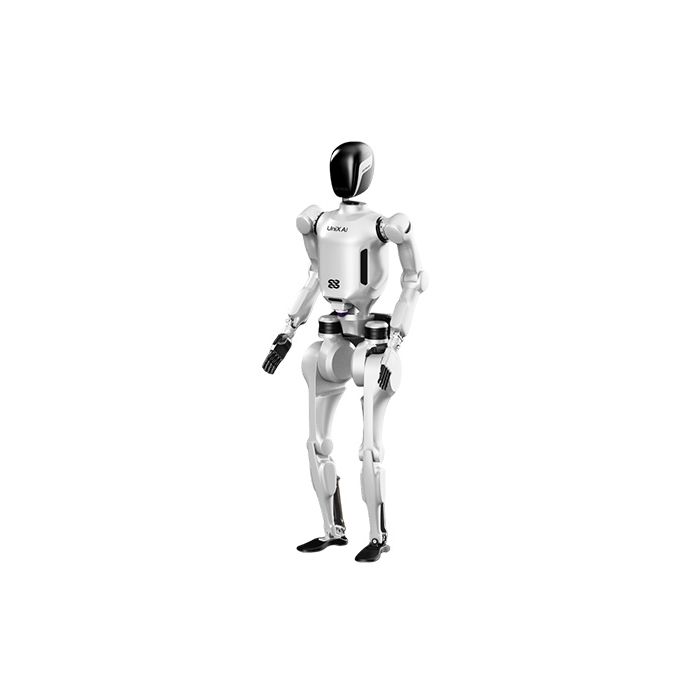
Martian follows a head–torso–two arms–two legs layout to align the robot’s reach, grasp, and locomotion with human environments (handles, stairs, countertops, switches). The bipedal base enables threshold and stair traversal that wheeled platforms cannot typically manage, while retaining a torso suitable for tool use and bimanual tasks.
Structure and actuation
Manufacturer specifications highlight high-performance vector control applied across the robot’s joints, with emphasis on precise torque tracking and fast response. This is paired with a fieldbus backbone (EtherCAT) for deterministic motion coordination and timing across drives and sensors.
Perception and HRI
Public materials describe a perception stack combining multi-camera vision with higher-level scene understanding, used for object localization, grasp selection, and navigation. The head unit is designed for human–robot interaction (HRI), supporting status signaling and conversational interfaces in service contexts. (The vendor page refers broadly to “combining perception with large-scale models”—a phrasing consistent with contemporary embodied-AI approaches.)
Safety and maintainability
As a platform intended for human-proximate operation, Martian’s design centers on force limits, emergency-stop circuitry, and guarded behaviors. The company’s positioning around productization—rather than research prototypes—implies attention to serviceability and fleet management, consistent with broader UniX AI communications about moving humanoids from demos to deployments at major industry events.
Technology and Specifications
-
Height: ~160 cm
-
Weight: ~50 kg
-
Maximum movement speed: up to 3 m/s (manufacturer figure)
-
Motor peak torque: up to 450 N·m
-
Total payload: 30–50 kg (class/variant dependent)
-
System bus: EtherCAT
-
Power module: listing indicates 9 Ah (battery subsystem details not fully disclosed on page)
-
Controls: self-developed vector control for joint precision and responsiveness
Controls & Autonomy. Martian’s motion layer centers on vector-controlled actuators synchronized over EtherCAT; high-level autonomy blends perception and planning, with the vendor referencing integration of large-scale models for perception-to-action policies. In typical deployments, human-in-the-loop supervision and task sequencing are expected—reflecting current best practices for safety and reliability in dynamic public spaces.
Applications and Use Cases
Facilities & hospitality
Bipedal mobility expands access to staircases, narrow passages, and multi-level layouts, making Martian a candidate for hotel operations, event venues, and front-of-house engagement, where reach and legged access can matter. Broader UniX AI communications emphasize real-world demonstrations at large showcases, reflecting a focus on deployable service workflows rather than lab-only trials.
Light industrial & logistics support
With a stated 30–50 kg payload class and robust torque capacity, Martian targets back-of-house material handling, tool-assisted tasks at workstations, and inspection rounds in human-scale infrastructure. The humanoid form factor allows the robot to use doors, ladders/steps, and human tools that are difficult for non-anthropomorphic platforms.
Research & education
Universities and corporate R&D groups may employ the platform for legged locomotion studies, bimanual manipulation, and multimodal perception research—especially where compatibility with human environments and anthropomorphic kinematics is essential for benchmarking.
Advantages / Benefits
-
Human-environment compatibility. Bipedal form factors can navigate stairs, thresholds, and irregular terrain without specialized infrastructure.
-
High joint torque & payload envelope. Published figures (up to 450 N·m peak torque; 30–50 kg total payload) point to tasks that require firm grasps and tool use at human height.
-
Real-world productization emphasis. The company’s CES-aligned messaging frames its lineup as engineered for scale, not just one-off prototypes.
-
Deterministic control network. EtherCAT plus vector control can improve synchronization and closed-loop stability for dynamic motions.
FAQ
What is the Unix AI Martian robot?
Martian is a bipedal, general-purpose humanoid robot by UniX AI designed for human-scale environments, combining legged mobility with dexterous manipulation and an embodied-AI stack.
How does Martian work?
It uses vector-controlled actuators synchronized over EtherCAT for precise joint control, fused with perception and large-model policies for navigation, grasping, and task execution under human-supervised workflows.
Why is Martian important?
Bipedal mobility enables access to stairs, thresholds, and human fixtures, extending robotics from flat-floor service to multi-level facilities and tasks requiring human-height reach and tool use.
What are Martian’s key specifications?
Manufacturer figures include ~160 cm height, ~50 kg mass, up to 3 m/s max speed, up to 450 N·m peak motor torque, 30–50 kg payload class, and EtherCAT system bus.
How does Martian compare with wheeled humanoids?
Bipeds gain stair/obstacle access; wheeled humanoids typically deliver longer runtime and simpler maintenance on flat floors. Choice depends on site layout and task portfolio.
Summary
The Unix AI Martian is a bipedal humanoid platform aimed at real-world service tasks where human-environment compatibility matters—stairs, thresholds, and human-height manipulation. The manufacturer emphasizes in-house core components, vector control with EtherCAT, and an embodied-AI stack to coordinate perception and actuation. While list pricing is not public, event-driven announcements and product pages suggest a path toward scalable deployments, with procurement dependent on configuration, regional certification, and support agreements.