Unix AI Wanda 2.0 Universal Wheeled Humanoid Robot
In stock
- BRAND:
- UNIXAI
- MODEL:
- WANDA 2.0
- ORIGIN:
- China
- AVAILABILITY:
- SUBJECT TO AVAILABILITY
- SKU:
- Unix-AI-Wanda-2.0
Design and Features
Form factor and mobility
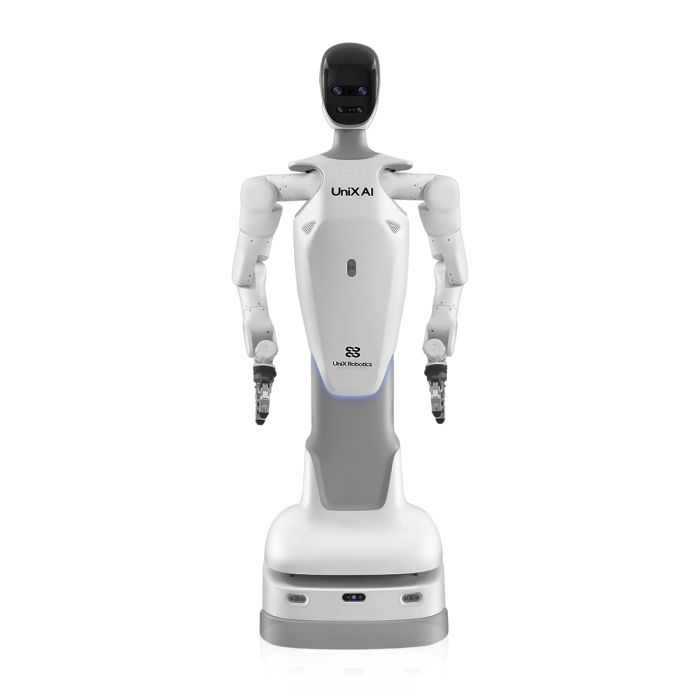
Wanda 2.0 uses a wheeled, full-size torso configuration with two articulated arms and a head module housing vision and interaction hardware. The wheeled base prioritizes stability, runtime, and payload over bipedal locomotion, making it suitable for long shifts on level indoor surfaces commonly found in hotels, homes, and retail spaces. Company materials position Wanda as a dual-arm humanoid rather than a compact toy-class robot.
Manipulation and end-effectors
The platform highlights dexterous manipulation, with references to 8-DoF arm modules and adaptive grippers capable of handling delicate and deformable items (e.g., soft tofu), textiles, and tableware—useful for housekeeping and kitchen tasks. The emphasis on compliant control suggests guarded, force-aware motions when working near people.
Perception and HRI
A multi-sensor suite supports object recognition, scene understanding, and human–robot interaction (HRI). Public demos and descriptions mention stereo/RGB cameras, potential depth sensing for grasping and navigation, and voice interaction for guided service encounters (concierge, reception, or room service).
Industrial design and maintainability
For day-to-day operations, the robot’s housing and joints are presented as serviceable and production-oriented, with claims of stable delivery capacity tied to mass-production lines. The vendor messaging targets deployment at scale rather than single-unit research showcases.
Technology and Specifications
Note: Specific component SKUs and full datasheets are not publicly standardized; the following aggregates vendor-published highlights and third-party summaries.
Actuation and degrees of freedom
-
Arms: Company and media notes cite 8-DoF bionic arms with compliant control for human-proximate manipulation.
-
Upper body & head: High-DoF joints for gaze, torso orientation, and coordinated two-hand tasks.
-
Base: Differential wheeled drive optimized for indoor floors and long duty cycles.
Perception stack
-
Vision: RGB (and likely depth) cameras for object detection, pose, and grasp point selection.
-
Proprioception & force: Joint sensing and gripper feedback for tactile-aware grasps and slip detection.
-
Environment: Semantic mapping for rooms, worktops, storage, and appliances. (Examples shown include dishwashing, table cleaning, laundry handling, and retail restocking.)
Embodied AI and control
UniX AI references an embodied AI stack with tactile intelligence (“UniTouch”) and learned manipulation primitives for robust, long-sequence tasks. Behavior appears to mix teleoperation for training, imitation-learning policies, and task planners that chain skills under supervision.
Compute, safety, and fleet
While chipsets are not disclosed, Wanda 2.0 is presented as an edge-compute robot running perception and control locally, with remote fleet management for updates and monitoring. Human-centric deployments imply speed/force limits, e-stops, and fallback behaviors for safe interaction in public venues. (Exact ratings are not published.)
Applications and Use Cases
Hospitality and housekeeping
Demonstrations and product pages feature routines for room turnover, table clearing, linen logistics, concierge greeting, and retail shelf replenishment—all scenarios with repeatable workflows and predictable layouts.
Household assistance
Videos and press posts show dishwashing, kitchen prep, laundry sorting, and general tidying, highlighting Wanda’s fine manipulation and task chaining in cluttered home environments.
Reception and brand activation
As a front-of-house greeter or demo bartender, Wanda 2.0 is used for engagement, guided interactions, and scripted service at exhibitions and events—illustrated by scheduled showcases tied to CES activity in early 2026.
Research & education
Given its dual-arm and perception-rich design, the platform can serve as a testbed for manipulation research, multimodal HRI studies, and workflow automation trials where wheeled mobility suffices.
Advantages / Benefits
-
Operational focus: A full-size, wheeled humanoid targets real, revenue-linked tasks (rooms, kitchens, retail), reducing risk compared with early-stage bipeds in dynamic spaces.
-
Dexterous manipulation: 8-DoF arms and tactile intelligence aim to deliver reliable grasps across deformable or fragile objects.
-
Scalability: Messaging around mass production and “configurable in hours” scenarios is oriented to multi-site roll-outs. (Organizations should validate on-prem conditions.)
-
Cost-to-value positioning: Wheeled locomotion can lower mechanical complexity and extend battery life versus bipedal designs, improving service economics in flat indoor spaces. (General industry rationale.)
FAQ
What is the Unix AI Wanda 2.0 humanoid robot?
Wanda 2.0 is a full-size, wheeled, dual-arm humanoid robot from UniX AI, designed for multi-scenario tasks such as housekeeping, reception, and household assistance.
How does Wanda 2.0 work?
It combines multi-modal perception, an embodied-AI stack (including tactile intelligence for grasping), and compliant dual-arm manipulation to execute long-sequence tasks under supervision and fleet management.
Why is Wanda 2.0 important?
The robot represents a push from humanoid demos to deployments, with an emphasis on mass-production and repeatable service workflows that can scale in homes, hotels, and retail spaces.
What are the benefits of a wheeled humanoid over a biped?
Wheeled humanoids commonly deliver longer runtime, simpler upkeep, and stable payload on indoor floors, while bipeds trade efficiency for stair/threshold access. The better option depends on site constraints and tasks.
Is Wanda 2.0 available outside China?
Media and press materials around CES 2026 indicate global outreach and demonstrations; buyers should confirm regional certifications, service coverage, and delivery timelines.
Summary
Wanda 2.0 is presented by UniX AI as a mass-produced, full-size, wheeled dual-arm humanoid aimed at service-grade deployments in homes, hotels, and retail environments. Its value proposition centers on dexterous manipulation, an embodied AI stack with tactile intelligence, and a form factor oriented to long duty cycles on indoor floors. With public messaging around scalable delivery and global events, Wanda 2.0 exemplifies the sector’s drive from proof-of-concept to operational use, while reminding buyers to validate site-specific requirements, integrations, and support prior to rollout.