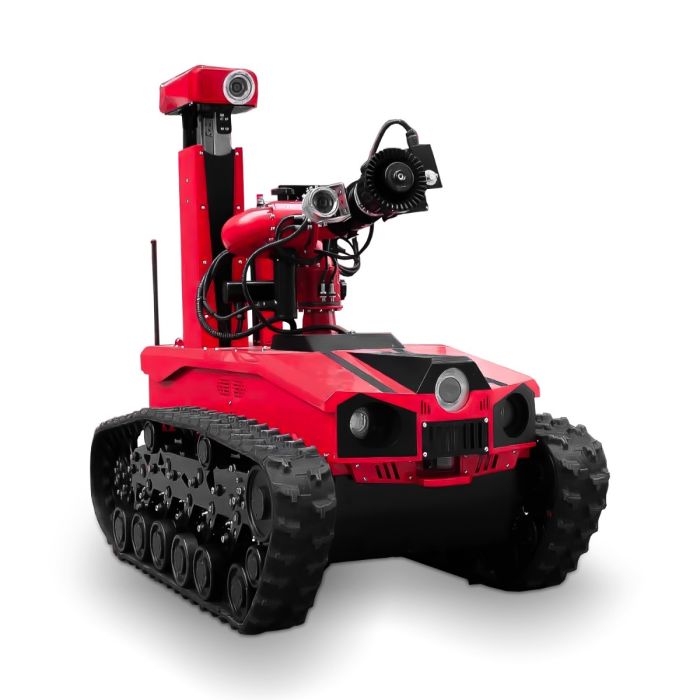
Guo Xing Explosion-proof Fire Extinguishing Reconnaissance Robot (RXR-MC80BD)
In stock
- BRAND:
- GUO XING
- MODEL:
- RXR-MC80BD
- ORIGIN:
- China
- Warranty:
- 12 MONTHS
- AVAILABILITY:
- SUBJECT TO AVAILABILITY
- SKU:
- Guo-Xing-RXR-MC80BD
Guo Xing Explosion-proof Fire Extinguishing Reconnaissance Robot (RXR-MC80BD)
As its name suggests, the RXR-MC80BD combines two core functions: fire extinguishing and reconnaissance. That dual role is important in hazardous industrial incidents, because responders often need both immediate suppression capability and reliable visual or situational awareness before committing crews into unstable zones. Guoxing’s product descriptions consistently frame the robot as a machine built not only to fight fires, but also to help assess dangerous scenes remotely.
The robot belongs to a category of industrial firefighting UGVs used in petrochemical plants, fuel storage facilities, gas installations, chemical manufacturing sites, and other high-risk environments. Third-party industrial listings and manufacturer material both place the RXR-MC80BD in the context of dangerous fire scenes involving explosive atmospheres and toxic conditions.
In practical terms, the RXR-MC80BD is best understood as a remote firefighting and disaster-scene reconnaissance robot optimized for public-safety and industrial emergency response. It is not a general service robot or a consumer product. Its role is closer to that of a robotic first-entry unit for severe fires and hazardous-material emergencies.
Design and Features
Explosion-proof firefighting architecture
One of the platform’s defining characteristics is its explosion-proof construction. Guoxing says the RXR-MC80BD was designed and produced to the GB3836-2010 standard, a key detail because the robot is specifically meant to operate in environments where combustible gases, vapors, or other ignition hazards may be present.
This explosion-proof positioning separates the RXR-MC80BD from ordinary outdoor robots or standard remote firefighting platforms. Its intended operating conditions include petrochemical refining, oil and gas storage, chemical manufacturing, and other hazardous industrial sites, according to third-party industrial listings that describe its target environments.
Fire extinguishing plus reconnaissance
The word “reconnaissance” in the product name is significant. It implies that the robot is meant to gather scene information in addition to projecting suppression streams. Guoxing’s own marketing language focuses on replacing firefighters in dense smoke, toxic, and low-oxygen conditions, which strongly suggests that the robot’s value lies in entering first, observing conditions, and supporting safer tactical decisions.
In emergency response, that combination matters because suppression without situational awareness can be ineffective or even dangerous. A robot that can approach a hazard, transmit reconnaissance information, and then assist with firefighting creates a more flexible response tool than a machine designed only to spray water or foam. This is an inference from the platform’s naming and official positioning.
Rugged obstacle-handling chassis
Guoxing describes the RXR-MC80BD as having a simple, stable body design and a high-power DC deceleration motor that makes obstacle crossing easier. Industrial listings also describe it as an all-terrain platform for hazardous scenes.
A third-party spec summary published on Scribd describes the chassis as an all-terrain high-strength crawler with an all-metal skeleton inside, which aligns with how this class of firefighting robot is generally built for industrial and rescue environments. Because that specific chassis detail comes from a third-party document rather than the clearest manufacturer page, it should be treated as supporting but not definitive documentation.
Technology and Specifications
Core published specifications
The most consistently published and manufacturer-backed specifications for the RXR-MC80BD are its explosion-proof intent and hazardous-environment mission. Guoxing explicitly states that the robot is:
-
designed to GB3836-2010 explosion-proof standard,
-
intended for inflammable, toxic, hypoxic, and smoke-filled disaster scenes,
-
and built to protect firefighters by replacing direct human entry in such environments.
A reseller listing also highlights a 1000 m remote control distance, which is plausible for a heavy firefighting UGV and consistent with how this class of robot is marketed, though this specific figure is more clearly published by reseller pages than by the retrieved official manufacturer snippets.
Mobility and terrain performance
A third-party technical summary gives several detailed performance figures for the RXR-MC80BD, including:
-
outline dimensions: 1780 × 900 × 1300 mm,
-
weight: ≤ 720 kg,
-
traction: 5800 N,
-
speed: 1.8/2.0 m/s,
-
obstacle crossing height: 260 mm,
-
roll angle: 35°.
These numbers are useful for understanding scale and mobility, but they come from a third-party document rather than directly from the clearest official Guoxing product page. They should therefore be treated as supporting specifications, not the only authoritative source. Even so, they fit the robot’s positioning as a heavy-duty firefighting and reconnaissance platform for rough industrial terrain.
Explosion-proof classification
The same third-party spec summary lists the explosion-proof type as Exd [ib] IIB T4 Gb. That marking is consistent with a robot intended for hazardous industrial atmospheres, especially in petrochemical and gas-related environments. Since this exact code did not appear in the retrieved official Guoxing snippets, it should be presented as a third-party published specification rather than a directly confirmed primary-source parameter.
Firefighting capacity and flow
Marketplace listings describe the RXR-MC80BD as a large-water-flow firefighting vehicle and emphasize its use for emergency rescue with remote operation. These listings support the idea that the platform is intended for serious suppression duty, although detailed manufacturer-published flow-rate numbers were not clearly exposed in the retrieved official snippets.
Because detailed public water-monitor and flow specifications were not fully visible in the official snippets reviewed here, it is more accurate to say that the robot is marketed for substantial firefighting output rather than to overstate exact extinguishing performance without a full datasheet.
Applications and Use Cases
Petrochemical and chemical fire response
The RXR-MC80BD is particularly well suited to petrochemical refining, oil and fuel-gas storage, and chemical manufacturing or storage sites. Third-party industrial sources explicitly mention these settings, which makes sense given the robot’s explosion-proof design and hazardous-environment mission.
In those environments, the robot’s value lies in reducing responder exposure to blast risk, toxic fumes, dense smoke, and oxygen-deficient atmospheres while still allowing suppression and initial scene reconnaissance. That aligns closely with the manufacturer’s stated purpose.
Fuel, gas, and storage incidents
The platform is also relevant in fuel depots, gas-storage facilities, transportation yards, and similar sites where fires can escalate quickly and where remote reconnaissance is critical before crews move in. Industrial listings specifically name storage and transportation sites as part of the intended deployment context.
Hazardous smoke and low-oxygen scenes
Guoxing repeatedly mentions hypoxia, toxic conditions, and thick smoke in its product descriptions. That makes the RXR-MC80BD useful not only in explosive industrial settings, but also in enclosed or semi-enclosed fire scenes where human situational awareness is degraded and respiratory hazards are severe.
Reconnaissance before human entry
A major use case is initial remote entry and reconnaissance. Even when firefighters eventually approach the scene, a robot like the RXR-MC80BD can help determine whether conditions are stable enough for human action. This is an inference, but it is strongly supported by the robot’s title, which explicitly combines fire extinguishing with reconnaissance.
Advantages / Benefits
Reduced firefighter risk
The biggest benefit of the RXR-MC80BD is that it helps keep human responders out of the most dangerous parts of the fireground. Guoxing explicitly says the robot is intended to replace fire-rescue personnel in hazardous disaster environments, directly addressing personal-safety concerns in toxic, explosive, and smoke-heavy conditions.
Purpose-built for explosive environments
Another advantage is that this is not just a generic remote firefighting robot. It is specifically marketed as explosion-proof, which is important for petrochemical, fuel, gas, and similar industrial settings where ignition risk is a core operational constraint.
Combined suppression and reconnaissance
The robot’s dual-role design adds operational flexibility. A platform that can contribute to both fire suppression and scene intelligence gathering is more versatile than a pure nozzle carrier. That combination can support faster hazard assessment, better tactical planning, and safer follow-up operations.
Strong mobility for industrial rescue
Supporting documents point to meaningful all-terrain capability, including crawler-based mobility and obstacle handling. Even though some of those finer figures come from third-party technical summaries, they fit the larger picture of a rescue robot designed for difficult industrial terrain rather than simple paved surfaces.
FAQ Section
What is the Guo Xing Explosion-proof Fire Extinguishing Reconnaissance Robot (RXR-MC80BD)?
The RXR-MC80BD is an explosion-proof firefighting robot designed for hazardous environments such as petrochemical, fuel, gas, and toxic smoke-filled disaster scenes. It combines remote fire suppression with reconnaissance capability.
How does the Guo Xing RXR-MC80BD work?
It works as a remotely operated firefighting UGV that can enter dangerous scenes, gather reconnaissance information, and assist with fire extinguishing while keeping human responders at a safer distance.
Why is the Guo Xing RXR-MC80BD important?
It is important because it is built for environments involving explosion risk, toxicity, smoke, and low oxygen, where sending human firefighters directly into the hazard can be extremely dangerous.
What are the benefits of the Guo Xing RXR-MC80BD?
Its main benefits are improved firefighter safety, explosion-proof suitability, combined fire extinguishing and reconnaissance, and mobility suited to difficult industrial rescue environments.
Is the RXR-MC80BD suitable for petrochemical sites?
Yes. Third-party industrial descriptions specifically identify petrochemical refining, oil and fuel-gas storage, and chemical manufacturing or storage sites as intended application areas for this robot.
Summary
The Guo Xing Explosion-proof Fire Extinguishing Reconnaissance Robot (RXR-MC80BD) is a purpose-built industrial firefighting UGV designed for some of the most dangerous emergency-response settings. Its core strengths are explosion-proof construction, remote firefighting capability, reconnaissance utility, and suitability for petrochemical and hazardous industrial incidents. While some detailed public performance figures come from third-party technical summaries rather than the clearest official datasheet, the overall role of the RXR-MC80BD is clear: it is a robot built to go where firefighters should not have to go first.