UBTECH VERCARI Cabinet Delivery Robot
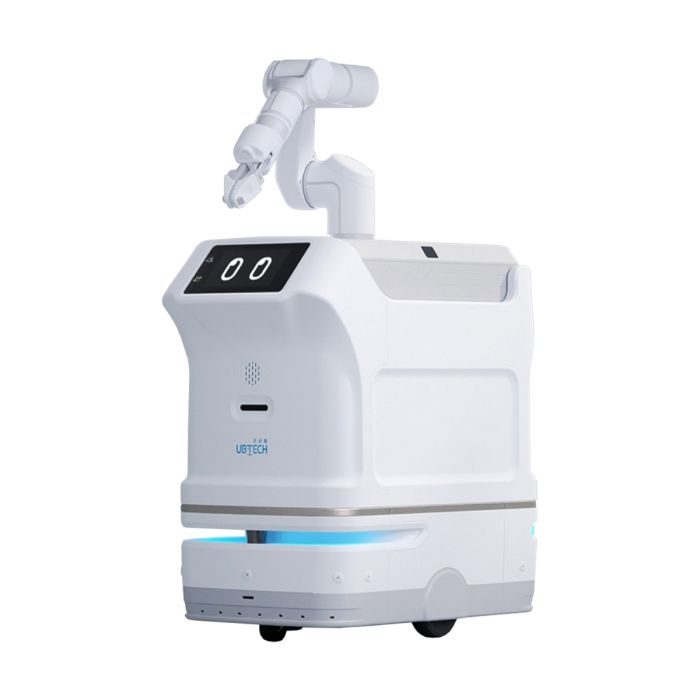
Marketed for use in hospitals and similar care environments, the platform emphasizes secure, contactless delivery using enclosed storage compartments (“cabinet” design) and autonomous navigation for routine point-to-point transport.
VERCARI is positioned within the healthcare robotics portfolio of UBTECH Robotics, a robotics company founded in 2012 and publicly listed in Hong Kong.
Design and Features
Cabinet-style storage and contactless workflows
A defining feature of VERCARI is its enclosed cabinet body, intended to reduce exposure and improve the organization of transported items compared with open-shelf delivery platforms. In healthcare settings, cabinet delivery robots are commonly associated with contactless workflows, helping reduce unnecessary staff movement for routine logistics tasks and supporting delivery to wards, nursing stations, or other internal destinations.
Human–robot interaction
VERCARI is built around a touchscreen interface (specified as a 10.1-inch screen) for local control and status visibility. In typical deployments, cabinet delivery robots are integrated into facility processes through scheduled routes, on-demand dispatch, and drop-off/pickup procedures that can be adapted to local operational policies.
Mobility and indoor maneuvering
The platform is sized for indoor corridors and building circulation. Published dimensions for VERCARI are 700 × 550 × 1,250 mm with a weight of 110 kg, reflecting a compact footprint relative to many service AMRs, while maintaining cabinet capacity.
Technology and Specifications
Navigation and sensing
VERCARI is described as using a multi-sensor perception and navigation stack that includes:
-
LiDAR ×2
-
RGB camera ×2
-
RGBD camera ×1
-
Ultrasonic sensors ×6
This sensor set is typical of indoor autonomous mobile robots (AMRs) that rely on range sensing (LiDAR/ultrasonic) for obstacle detection and mapping, and vision (RGB/RGBD) for additional perception and scene understanding.
Drive performance (published)
VERCARI’s published motion characteristics include:
-
Maximum speed: 1.2 m/s
-
Maximum climbing angle: 5°
-
Maximum crossing height: 15 mm
-
Maximum crossing width: 50 mm
These values indicate a robot tuned for smooth indoor surfaces, thresholds, and mild ramps typical of modern facilities.
Power and charging
The published electrical specifications include:
-
Battery capacity: 20 Ah
-
Rated voltage: 48 V
-
Endurance (runtime): 8 hours
-
Charging method: automatic charging
An 8-hour rated endurance is commonly aligned with partial-shift coverage, with “automatic charging” typically enabling opportunistic or scheduled docking to minimize downtime.
Environmental and operating parameters
VERCARI lists typical indoor operating constraints:
-
Operating temperature: 0–40°C
-
Noise: ≤ 55 dB
Noise ratings in this range are relevant for healthcare and eldercare environments where quiet operation can be important.
Applications and Use Cases
Hospitals and clinics
In hospital logistics, cabinet delivery robots like VERCARI are generally used for repeated internal transport tasks, such as moving small supplies between storage areas and clinical departments, delivering routine items to wards, or supporting administrative document distribution. VERCARI is explicitly marketed as a healthcare product, aligning it with these workflows.
Elder care and long-term care facilities
Care facilities often require frequent, time-sensitive delivery of items (meals, linens, personal items, consumables). A cabinet delivery robot can help standardize delivery runs and reduce staff time spent walking routes—particularly in larger buildings—while maintaining separation between items during transport.
Secure or controlled internal deliveries
A cabinet form factor is commonly associated with controlled access and compartment-based delivery, which may be useful when facilities want to reduce mix-ups (e.g., ward-to-ward deliveries) or support facility procedures where items must remain enclosed during transit.
Advantages / Benefits
Operational efficiency for routine logistics
By automating repeated point-to-point deliveries, cabinet delivery robots can reduce time spent on walking tasks and allow staff to focus on higher-value activities. This is particularly relevant in healthcare environments, where routine internal logistics can be frequent and labor-intensive.
Contactless delivery in sensitive environments
Healthcare robotics adoption often highlights contactless transport and reduced unnecessary interpersonal contact around routine delivery activities. VERCARI is marketed within this context as a healthcare delivery platform.
Sensor redundancy for indoor navigation
The listed combination of LiDAR, cameras (including depth), and ultrasonic sensors suggests a navigation system designed to handle dynamic indoor spaces—corridors with pedestrians, carts, and intermittent obstacles—by using multiple sensing modalities
FAQ Section
What is UBTECH VERCARI?
UBTECH VERCARI is a cabinet-style healthcare delivery robot designed for indoor, autonomous transport of items in hospitals and care facilities, using multi-sensor navigation and an enclosed body for delivery workflows.
How does the VERCARI cabinet delivery robot work?
VERCARI navigates indoors using a sensor suite that includes dual LiDAR, multiple cameras (RGB and RGBD), and ultrasonic sensors to perceive obstacles and move between destinations. It is also specified to support automatic charging for routine operation.
Why are cabinet delivery robots important in healthcare?
Cabinet delivery robots can help automate routine internal logistics, supporting contactless transport and reducing time spent on repeated delivery routes—important in environments where staff time and workflow consistency matter.
What are the benefits of UBTECH VERCARI?
Key benefits include cabinet-style enclosed transport, healthcare-oriented navigation sensors (LiDAR + cameras + ultrasonic), and published operating characteristics such as 8-hour endurance, ≤55 dB noise, and automatic charging support.
Summary
UBTECH VERCARI is a cabinet delivery robot designed for healthcare logistics, combining enclosed transport with a multi-sensor navigation stack (LiDAR, RGB/RGBD cameras, and ultrasonic sensors), practical indoor mobility limits, and automatic charging. Its published specifications—compact footprint, quiet operation, and shift-length endurance—reflect a platform aimed at routine, contactless delivery workflows in hospitals and care environments.