
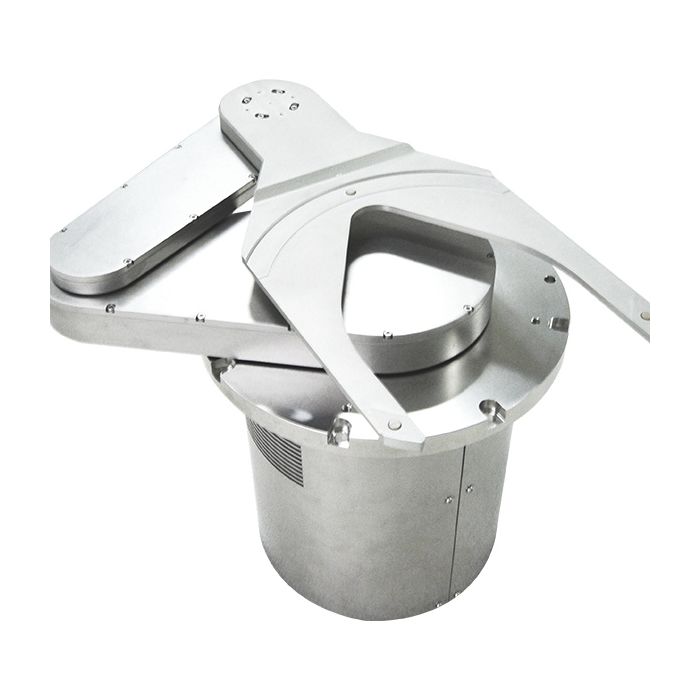
SIASUN SRBZ820C (SRBZ820C)
In stock
- BRAND:
- SIASUN
- PART #:
- SRBZ820C
- ORIGIN:
- China
- AVAILABILITY:
- SUBJECT TO AVAILABILITY
- SKU:
- SIASUN-SRBZ820C
SIASUN SRBZ820C (SRBZ820C)
In SIASUN’s product positioning, SRBZ820C is associated with semiconductor- and vacuum-process automation workflows, where robots operate inside or adjacent to vacuum chambers and transfer modules to move sensitive substrates (commonly wafers or similar workpieces) between process steps.
The SRBZ820C is commonly characterized by vendor listings as a SEMI-certified solution emphasizing high reliability (with a listed MCBF value), magnetic-fluid sealing, and steel-belt transmission, alongside motion-control features intended to improve productivity in automated vacuum transfer tasks.
SIASUN (also known as SIASUN Robot & Automation) is an established robotics and automation supplier that provides robot products, core components, and industry solutions for global customers.
Design and Features
Vacuum-compatible architecture
Vacuum-transfer robots typically require design choices that differ from standard factory-floor manipulators, including:
-
Sealing and leak-control strategies to preserve vacuum integrity
-
Low outgassing materials and surface treatments to reduce contamination risk
-
Motion systems optimized for repeatability rather than human-safe collaboration
For the SRBZ820C, product listings specifically highlight magnetic fluid sealing, a technique commonly used in vacuum systems to help isolate internal drive components while maintaining vacuum compatibility.
Transmission and motion mechanics
The SRBZ820C is described as using steel belt transmission, a choice often associated with smooth motion delivery and reduced particulate generation compared with certain alternatives, depending on implementation.
Control, safety, and productivity functions
Vendor descriptions for SRBZ820C emphasize a networked control system, anti-collision protection, and dynamic deviation correction—features that are typically intended to:
-
reduce unplanned stops and damage risk,
-
maintain path accuracy during repeated transfers, and
-
support higher throughput in automated tool clusters.
Listings also describe trajectory planning improvements to enhance motion rhythm and overall productivity.
Technology and Specifications
Core specification themes (as commonly listed)
Public vendor listings for SRBZ820C frequently present the following headline specification points:
-
SEMI certified (as listed)
-
MCBF > 10M (as listed)
-
Magnetic fluid sealing
-
Steel belt transmission
Note: Detailed parameters such as exact payload, reach, wafer size compatibility, axis configuration, or vacuum pressure range are not consistently published in the readily accessible public snippets above; these are typically confirmed in an OEM datasheet, integration manual, or quotation package.
Reliability metric (MCBF)
MCBF (“mean cycles between failures”) is a reliability metric commonly used in high-volume automation, especially where “cycles” correspond to repetitive pick-and-place or transfer operations. The SRBZ820C is listed with MCBF > 10M, signaling an emphasis on long-run operation before a failure event, consistent with semiconductor tool uptime requirements.
System context within SIASUN’s robotics portfolio
SIASUN markets a broad range of robotics products and automation systems, including industrial robots that integrate sensing, cognition/decision support concepts, and application-tailored solutions across sectors.
In parallel, SIASUN also describes “special robot” categories that can span high-speed, multi-axis movement and extended strokes, reflecting the company’s wider automation capabilities beyond a single robot type.
Applications and Use Cases
Semiconductor vacuum cluster tools
A primary use case for vacuum robots like SRBZ820C is within vacuum cluster tool architectures, where substrates move among:
-
load locks,
-
transfer chambers,
-
process modules (etch, deposition, anneal, etc.), and
-
metrology/inspection stages.
In these environments, the robot’s role is to deliver repeatable, contamination-controlled transfers that maintain tool throughput while protecting fragile, high-value substrates.
Cleanroom automation and contamination-sensitive handling
SRBZ820C is described as a vacuum cleanroom robot, aligning it with processes that require strict particulate control and consistent handling paths.
Typical cleanroom-driven requirements include:
-
controlled acceleration/deceleration profiles to prevent substrate slip,
-
collision avoidance to protect end effectors and chamber hardware,
-
stable repeatability to reduce process variance.
High-throughput repetitive transfer lines
Where a vacuum handling cell repeats the same motions thousands of times per day, functions like dynamic deviation correction and improved trajectory planning can be operationally significant by reducing cumulative drift and minimizing slowdowns from micro-collisions or alignment retries.
Advantages / Benefits
Vacuum compatibility with sealing emphasis
The explicit mention of magnetic fluid sealing highlights vacuum-system compatibility and suggests attention to vacuum boundary integrity and contamination control.
Reliability positioning for industrial uptime
An MCBF > 10M listing aligns the SRBZ820C with uptime-driven industries that measure productivity by sustained cycle counts and minimized tool downtime.
Productivity-oriented control features
The combination of a networked control system, anti-collision protection, dynamic deviation correction, and trajectory planning improvements is commonly associated with:
-
faster recovery from minor disturbances,
-
fewer stoppages due to collisions or misalignment, and
-
smoother motion profiles that can increase throughput.
FAQ Section
What is the SIASUN SRBZ820C?
The SIASUN SRBZ820C is a vacuum cleanroom robot designed for automated transfer tasks in vacuum-process automation, commonly associated with semiconductor and vacuum tool handling.
How does the SRBZ820C work?
The SRBZ820C performs repeatable robotic transfer motions inside or adjacent to vacuum chambers using vacuum-oriented design elements (including magnetic fluid sealing) and a motion/control system described as networked and productivity-focused.
Why is the SRBZ820C important?
In vacuum manufacturing, tool uptime and contamination control are critical. SRBZ820C is marketed with reliability and control features such as MCBF > 10M, anti-collision protection, and deviation correction, all aimed at supporting stable high-volume operation.
What are the benefits of the SRBZ820C?
Commonly listed benefits include vacuum-oriented sealing, steel belt transmission, high reliability (MCBF > 10M), and control features such as anti-collision protection, dynamic deviation correction, and trajectory planning intended to improve productivity.
Summary
SIASUN SRBZ820C (SRBZ820C) is positioned as a vacuum cleanroom robot for vacuum-process automation, emphasizing SEMI-listed certification, MCBF > 10M, magnetic fluid sealing, and steel belt transmission, supported by control features such as anti-collision protection, dynamic deviation correction, and improved trajectory planning. Its primary value lies in enabling repeatable, contamination-aware transfers in uptime-critical vacuum manufacturing workflows.