
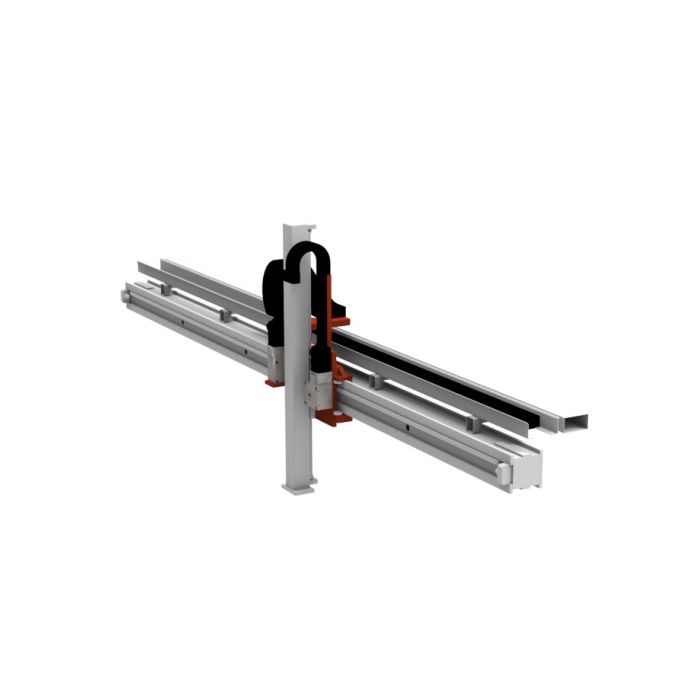
SIASUN MGI Truss Robot (MGI Truss Robot)
In stock
- BRAND:
- SIASUN
- PART #:
- MGI Truss Robot
- ORIGIN:
- China
- AVAILABILITY:
- SUBJECT TO AVAILABILITY
- SKU:
- SIASUN-MGI-Truss-Robot
SIASUN MGI Truss Robot (MGI Truss Robot)
This architecture is widely used for high-throughput pick-and-place, machine tending, pallet handling, and in-line transfer tasks where repeatability, predictable motion, and integration with conveyors or workstations are priorities.
SIASUN describes the MGI Truss Robot as a standardized modular product intended to be highly adaptable, with flexible combinations and easy installation—features that align with modern “configurable automation” approaches used in factories where layouts and product mixes change over time.
SIASUN (Siasun Robot & Automation Co., Ltd.) is a Chinese robotics and automation manufacturer known for industrial robots and mobile robots (including AGVs), among other automation products.
Design and Features
Modular gantry architecture
The MGI Truss Robot is generally presented as part of a modular truss-robot concept: the system can be assembled and scaled using standardized components, allowing integrators to tailor the robot to the required workspace and payload. SIASUN’s product positioning emphasizes flexible combination and ease of installation, suggesting a design intended for faster deployment than fully custom gantry builds.
Typical configuration elements
While exact configurations vary by project, truss robots in the “M-series” style are commonly composed of:
-
Linear axis modules (X/Y) mounted to a frame, elevated rails, or overhead structure
-
A vertical Z-axis for approach and placement
-
Optional rotary axes at the tool flange (for orientation tasks)
-
End-effector tooling (grippers, clamps, vacuum cups, forks, magnetic heads, etc.)
-
Sensors and safety (encoders, limit switches, safety scanners/light curtains, emergency stop chains)
A notable feature frequently highlighted for SIASUN’s modular truss robot family is the use of rectangular guide rails and a design approach that supports large work envelopes, including effectively “unlimited” X-axis extension in principle (implemented via track length selection and structural design).
Integration and automation readiness
In production settings, MGI-style truss robots are typically integrated with:
-
PLC and factory control systems
-
Conveyors and pallet lines
-
Machine tools (CNC, stamping presses, injection molding, packaging cells)
-
Vision systems (2D/3D) for part localization and inspection
-
MES/WMS interfaces for order-driven automation (common in smart manufacturing)
Technology and Specifications
Motion model and performance envelope
Truss robots use Cartesian motion along linear axes, which can be advantageous for:
-
High repeatability across long travel distances
-
High speed on straight-line moves
-
Predictable cycle-time engineering in production lines
Public product listings for SIASUN’s modular truss robot family indicate a payload range that can extend from small loads into multi-ton handling—depending on the selected modules and configuration. One public listing for SIASUN’s Modular Truss Robot (M Series) describes a payload range of 1–5000 kg and a maximum speed up to 240 m/min (values typically associated with long-axis travel in gantry systems).
Another description of SIASUN’s modular truss-robot line describes load handling in the 1–3000 kg class and emphasizes high speed and modularity.
Important note on specificity: SIASUN’s public “MGI Truss Robot” product listing is brief and does not publish a full parameter sheet (e.g., stroke lengths, axis accelerations, positioning accuracy, controller model, or safety rating). In practice, these values are commonly finalized per project because gantry robots are frequently engineered to the facility layout, tooling, and payload.
Control and sensing (typical for industrial gantry robots)
Although vendor-specific details vary, modern truss robots commonly include:
-
Servo-driven axes with absolute/relative encoders
-
Safety circuits (E-stops, interlocks, safe torque off)
-
Optional safe motion features (depending on the controller and safety architecture)
-
Path planning or programmed waypoint motion for repeatable cycles
-
Optional vision-guided picking for variable part presentation
Applications and Use Cases
Machine tending and process feeding
A common deployment is machine tending, where the truss robot loads/unloads parts to:
-
CNC machines
-
stamping and forming presses
-
heat treatment stations
-
inspection gauges
The overhead gantry layout can keep floor space open while spanning multiple machines.
Palletizing, depalletizing, and line transfer
MGI-style truss robots are often used to transfer products or totes between:
-
conveyor segments
-
pallet positions
-
buffer racks
-
packaging lines
This is especially relevant in high-volume facilities where cycle time and predictable throughput are critical.
Heavy or bulky handling
With configurations that scale into the high-payload range, modular truss robots can support handling of:
-
fixtures and jigs
-
vehicle components
-
large castings or battery-module carriers
-
industrial containers and pallet loads
(Exact payload capability depends on the chosen configuration and structural engineering.)
Advantages / Benefits
Predictable precision over large work areas
Gantry motion along linear rails is well-suited to long travel distances and rectangular work envelopes, making it easier to model and optimize line balancing.
Flexible modular expansion
The MGI Truss Robot is marketed as a standardized modular product with flexible combinations and easier installation, which can reduce lead time for system changes compared with fully custom automation.
Factory-space efficiency
Overhead or elevated truss robots can free floor space for people, carts, and other equipment, improving facility layout efficiency.
Scalability for payload and reach
Public descriptions of SIASUN’s modular truss family indicate broad payload scalability (from small parts to multi-ton handling) and high-axis travel speed, enabling use in both light automation and heavy industry scenarios.
FAQ Section
What is a SIASUN MGI Truss Robot?
A SIASUN MGI Truss Robot is a modular gantry (Cartesian) industrial robot designed for automated handling and process support. It is marketed as a standardized modular product with flexible combinations and easier installation.
How does a truss (gantry) robot work?
A truss robot moves a tool along linear axes (commonly X/Y/Z). Motors drive each axis along rails or beams, positioning a gripper or other end-effector to pick, place, load, or transfer items within a defined work envelope.
Why are truss robots important in modern manufacturing?
Truss robots help improve throughput, repeatability, and safety by automating repetitive material movement and machine tending. Their large rectangular work envelope can cover multiple stations and reduce manual handling, especially in high-volume lines.
What are the benefits of a modular truss robot system?
Common benefits include scalable payload and reach, high-speed linear travel, and the ability to build customized layouts from standardized modules. Public listings for SIASUN’s modular truss family describe wide payload capability (reported up to 5000 kg for the M Series listing) and high maximum speed (reported up to 240 m/min), depending on configuration.
Summary
The SIASUN MGI Truss Robot represents a modular, gantry-style automation approach aimed at scalable industrial handling and line-integration tasks. Positioned as a standardized modular product with flexible combination and easier installation, it fits factories seeking repeatable, high-throughput Cartesian motion across large work envelopes, especially where payload and travel length must be engineered to the application.