SIASUN High-Level Stacking Forklift Mobile Robot
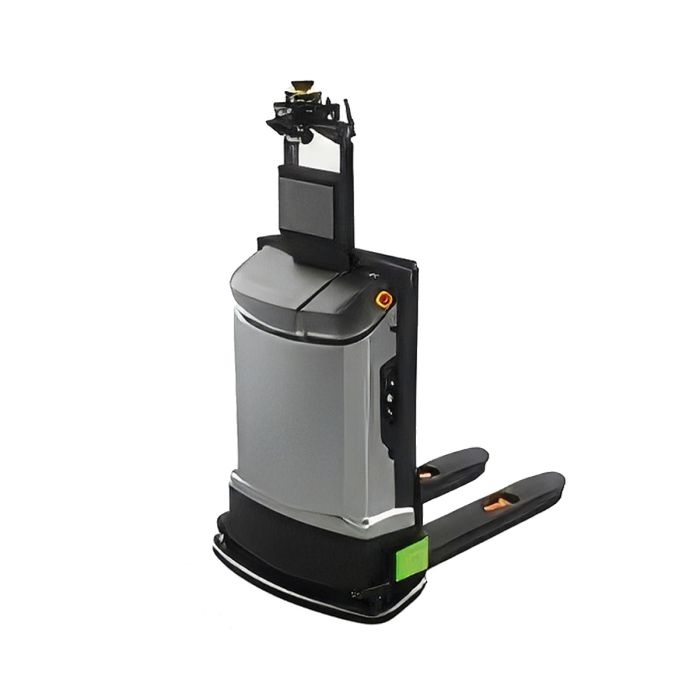
In stock
- BRAND:
- SIASUN
- PART #:
- High-Level Stacking Forklift Mobile Robot
- ORIGIN:
- China
- AVAILABILITY:
- SUBJECT TO AVAILABILITY
- SKU:
- SIASUN-High-Level-Forklift
SIASUN High-Level Stacking Forklift Mobile Robot
In SIASUN’s mobile robot portfolio, high-level stacking forklift robots belong to the broader family of forklift-type mobile robots (AGVs/AMRs) that combine a powered lift mast with autonomous navigation, enabling them to perform tasks traditionally handled by human-operated reach trucks or forklifts—such as putaway, replenishment, line feeding, and internal material transfers—while integrating with modern warehouse execution and manufacturing systems.
SIASUN (Shenyang SIASUN Robot & Automation Co., Ltd.) is a robotics and intelligent manufacturing solutions company established in 2000, with product lines that include mobile robots used for industrial logistics and automation.
Design and Features
Forklift-style lifting architecture
High-level stacking forklift mobile robots are characterized by a lifting mast and fork carriage (or compatible load-handling attachment) mounted on a mobile base. The “high-level stacking” concept typically refers to higher lift ranges used in racking and warehouse storage, enabling automated putaway and retrieval at elevated heights. In SIASUN’s forklift-type mobile robot lineup, published lift-height ranges can extend from hundreds of millimeters up to several meters, depending on configuration and mast type.
Load handling and pallet interaction
These robots are commonly designed for:
-
Pallet handling (e.g., Euro pallets, GMA pallets, and custom load carriers)
-
Rack-facing operations (putaway/retrieval)
-
Dock-to-line feeding (bringing components or finished goods to production areas)
Depending on the facility’s material flow, high-level stacking forklift robots may support accessories such as side-shift, fork positioners, safety bumpers, or dedicated load interfaces (application-dependent).
Human-safe, facility-safe operation features
In practice, forklift AMRs/AGVs rely on layered safety and control measures—such as obstacle detection, speed limits in shared zones, and safety-rated stop behaviors—aligned to industrial mobile robot safety guidance and standards used for driverless trucks and AMRs/AGVs (e.g., ISO 3691-4 is widely referenced in industry discussions).
Technology and Specifications
Navigation and positioning
SIASUN forklift-type mobile robots are commonly offered with multiple navigation approaches to match site conditions and cost/accuracy needs. For example, SIASUN product listings describe options such as Laser SLAM navigation and QR code navigation.
Typical capabilities (model/configuration dependent) may include:
-
Autonomous route planning within mapped areas (SLAM-based)
-
Marker-based navigation in structured lanes (QR code-based)
-
Station/docking alignment for pallet pickup and drop-off
Motion performance
Representative SIASUN forklift-type mobile robot listings include operational figures such as:
-
Maximum speed up to ~1.5 m/s (application and safety-zone dependent)
-
Positioning accuracy on the order of ±10 mm (listed for specific configurations)
-
Turning radius specifications (important for aisle design and rack approach geometry)
Payload and lift height (typical ranges)
For high-level stacking forklift mobile robots, the key sizing variables are rated load and lift height. In SIASUN’s forklift-type mobile robot listings, examples include:
-
Rated load around 250 kg (representative models)
-
Lift-height ranges spanning roughly 300 mm up to 4,000 mm in specific product pages, and listings that reference lift heights extending up to 6,000 mm across the category (depending on mast/configuration).
In real deployments, “high-level” implementations are typically selected to match rack beam heights, aisle widths, load dimensions, and required throughput.
Power system and endurance
Warehouse forklift AMRs typically use battery-electric power and are designed for multi-hour operation. SIASUN forklift-type mobile robot pages cite endurance in the range of about 6–8 hours for certain configurations.
Control, integration, and fleet management
High-level stacking forklift mobile robots are usually deployed as part of a larger logistics automation system that may include:
-
Fleet scheduling and traffic control (intersection management, right-of-way rules, congestion control)
-
WMS/WES/MES integration for tasks like putaway, replenishment, kitting, and line feeding
-
Digital mapping and zone configuration (speed-restricted areas, shared pedestrian zones, no-go regions)
Applications and Use Cases
Warehouse putaway and retrieval
A core use case is automated pallet putaway into racks and retrieval for outbound staging. High-level stacking forklift mobile robots can reduce travel time variability and support predictable cycle times in repetitive warehouse workflows.
Manufacturing line-side replenishment
In discrete manufacturing, forklift mobile robots can deliver palletized components from receiving or supermarkets to line-side buffers, supporting lean replenishment and reducing dependence on manual forklift traffic.
Intralogistics in mixed facilities
Facilities that combine production, warehousing, and staging can use forklift AMRs as “mobile elevators” for standardized loads—moving items between zones while maintaining traceability and task logging.
Industry verticals
Mobile robots in SIASUN’s portfolio are positioned for use in areas such as automotive manufacturing, electronics production, and medical equipment manufacturing, reflecting common sectors where structured material flow and repeatable transport tasks create strong ROI for automation.
Advantages / Benefits
Higher rack utilization and automated high stacking
High-level stacking forklift mobile robots enable automated access to higher rack levels, supporting storage density improvements and reducing manual high-reach driving tasks.
Safety and traffic reduction
Replacing portions of manual forklift travel with autonomous operations can reduce cross-traffic, standardize routes, and support safety zoning—particularly in facilities with mixed pedestrian/vehicle areas (implementation-dependent and subject to local safety validation).
Consistency and traceability
Robotic forklift missions can be logged end-to-end, improving inventory traceability, auditability, and operational analytics (task times, congestion points, exception types).
Scalability through fleet expansion
Many deployments begin with a small fleet for one workflow (e.g., putaway) and expand to additional workflows (replenishment, transfer, staging) as facility mapping and integration mature.
FAQ Section
What is a SIASUN High-Level Stacking Forklift Mobile Robot?
It is an autonomous forklift-style mobile robot designed to lift and stack loads at elevated heights for warehouse and factory intralogistics, using onboard navigation and control to perform putaway, retrieval, and transport tasks.
How does a high-level stacking forklift mobile robot work?
The robot receives a job (e.g., “pick pallet A and place it in rack location B”), navigates autonomously (often using Laser SLAM or QR-based navigation), aligns to the load, lifts it with the mast/forks, travels to the destination, and places it at the target location while following configured safety and traffic rules.
Why are high-level stacking forklift robots important?
They help facilities automate rack storage operations, reduce repetitive manual forklift driving, improve process consistency, and support scalable intralogistics—especially where high stacking and frequent pallet moves create bottlenecks.
What are the benefits of a SIASUN high-level stacking forklift mobile robot?
Common benefits include automated high stacking, improved throughput consistency, reduced forklift traffic in defined workflows, and better task traceability. Depending on the model, SIASUN listings also indicate features such as multi-hour endurance and configurable navigation options.
Summary
The SIASUN High-Level Stacking Forklift Mobile Robot is a forklift-style autonomous mobile robot designed for pallet transport and elevated stacking in modern warehouses and factories. By combining autonomous navigation, fleet-style tasking, and lift-mast handling, it targets high-frequency intralogistics workflows—especially putaway, retrieval, and replenishment—where automation can improve consistency, safety management, and scalability.