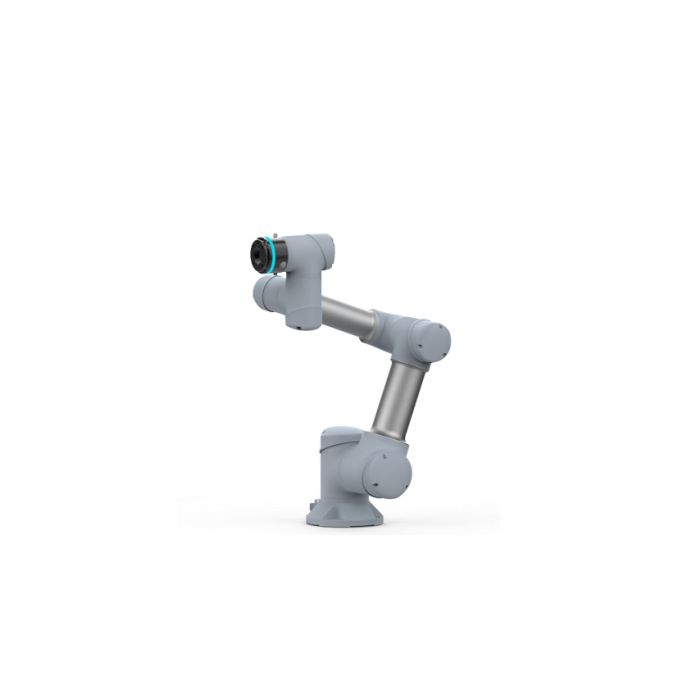
SIASUN GCR7-910 (GCR7-910)
In stock
- BRAND:
- SIASUN
- PART #:
- GCR7-910
- ORIGIN:
- China
- AVAILABILITY:
- SUBJECT TO AVAILABILITY
- SKU:
- SIASUN-GCR7-910
SIASUN GCR7-910 (GCR7-910)
Collaborative robots like the GCR7-910 typically emphasize ease of deployment, rapid re-tasking, and built-in safety functions intended to reduce integration complexity for high-mix production. In practical deployments, cobots are often paired with end-of-arm tooling (EOAT) such as grippers, screwdrivers, dispensers, or small welding torches, and may integrate with vision systems and factory networks to support semi-automated workcells.
Design and Features
Collaborative form factor
The GCR7-910 follows the common cobot architecture: a compact, articulated arm with an integrated controller and a programming interface designed for non-specialist setup. SIASUN describes the GCR series as supporting user-friendly programming methods (including “drag-and-drop” style workflows and guided teaching) to shorten commissioning time and enable faster changeovers between tasks.
Safety and human–robot collaboration
A defining characteristic of cobots is the integration of safety-oriented functions that help support operation in shared workspaces when appropriately risk-assessed and configured. The GCR7-910 specification set includes safety-related functions such as power-and-force limiting, collision detection, and speed/force-related protective behaviors consistent with collaborative deployment approaches. SIASUN’s GCR documentation also references third-party safety assessment/certification activity (e.g., TÜV-related statements) for the series.
Environmental and production-oriented options
For industrial environments, cobots are often selected not only for reach and payload but also for practical deployment considerations: footprint, mounting flexibility, and suitability for typical workshop conditions. The GCR7-910 is specified with an IP54 protection rating and operating conditions aligned with indoor industrial environments.
Technology and Specifications
Kinematics and motion system
The SIASUN GCR7-910 is a 6-axis collaborative robot, providing six degrees of freedom (6 DOF) to position and orient tools in 3D space—an arrangement widely used for assembly, servicing machines, and general-purpose automation.
Key performance specifications
Commonly cited specifications for the GCR7-910 include:
-
Rated payload: 7 kg
-
Reach (maximum arm radius): 910 mm
-
Degrees of freedom: 6 axes
-
Repeatability: ±0.03 mm
-
Maximum TCP speed: up to 2 m/s
-
Ingress protection: IP54
The robot’s joint ranges and maximum joint speeds are also commonly presented in SIASUN’s technical documentation as part of motion planning and cycle-time estimation (e.g., per-axis rotation limits and angular speed ceilings).
Integration and connectivity
Industrial cobots typically function as networked automation components. The GCR7-910 documentation lists interfaces and protocols intended for integration into factory control environments, including Ethernet and industrial communication options such as Modbus TCP and PROFINET (as specified).
Power and operating conditions
The GCR7-910 is specified for single-phase AC power (200–240 V, 50/60 Hz) and an operating temperature range commonly associated with standard indoor production sites (documented as 0–50°C).
Applications and Use Cases
Assembly and fastening assistance
With a 910 mm reach and 7 kg payload, the GCR7-910 is suited for assembly-adjacent operations such as screwdriving, light press-fit support (when paired with appropriate tooling and force control), and component placement. Repeatability values on the order of hundredths of a millimeter are often used to support consistent positioning for fixtures and jigs in semi-automated assembly workflows.
Machine tending and pick-and-place
Cobots are frequently deployed to load/unload CNC machines, test stations, and packaging equipment—especially where a compact footprint and re-tasking are valued. In these scenarios, the robot may be configured with grippers, vacuum tooling, or magnetic EOAT, and integrated with basic sensors or vision to handle part orientation variability.
Quality inspection and vision-guided tasks
SIASUN’s GCR materials explicitly position the series for compatibility with machine vision options. Vision-guided cobot cells are commonly used for inspection, presence/absence checks, simple metrology screening, and guided picking where part presentation varies.
Electronics and precision handling environments
Documentation for the series also highlights ESD-related positioning (often relevant to electronics handling), which can matter in 3C electronics, light assembly, and test/inspection benches where electrostatic precautions are required as part of the overall cell design.
Advantages / Benefits
Faster deployment for high-mix automation
Collaborative robots are commonly selected for applications where time-to-deploy and ease of redeployment are major drivers. Tool changes, program adjustments, and the ability to reposition a cell can reduce downtime when product variants change frequently. SIASUN’s GCR positioning emphasizes simplified programming methods intended to support these workflows.
Compact workcells and flexible mounting
A ~1 m reach class cobot can be mounted on benches, mobile carts, pedestals, or inside compact machine-tending enclosures. This can be useful in space-constrained manufacturing lines where adding a large robot and fence would be impractical.
Integration into modern factory networks
With Ethernet-based integration and listed support for industrial protocols, cobots can be incorporated into production monitoring, traceability, and line control architectures.
FAQ Section
What is the SIASUN GCR7-910?
The SIASUN GCR7-910 is a 6-axis collaborative robot designed for flexible automation. It is specified for 7 kg payload and 910 mm reach, making it suitable for assembly, machine tending, and inspection tasks.
How does the SIASUN GCR7-910 work?
Like most cobots, it uses servo-driven joints across six axes to position an end-effector (such as a gripper or tool). It is designed to integrate with factory systems through Ethernet and specified industrial protocols, and it supports guided teaching/programming workflows.
Why is the SIASUN GCR7-910 important?
Cobots in the GCR class are often used to automate repetitive steps while keeping workcells compact and reconfigurable. The GCR7-910’s reach/payload class targets common automation needs in high-mix production where fast redeployment matters.
What are the benefits of the SIASUN GCR7-910?
Commonly cited benefits include 6-axis flexibility, 910 mm reach, 7 kg payload, and repeatability of ±0.03 mm, plus industrial integration options and cobot-oriented safety functions when properly configured and risk-assessed
Summary
The SIASUN GCR7-910 is a mid-range 6-axis collaborative robot specified for 7 kg payload, 910 mm reach, and ±0.03 mm repeatability, designed for flexible automation in assembly, machine tending, and inspection-oriented workcells.