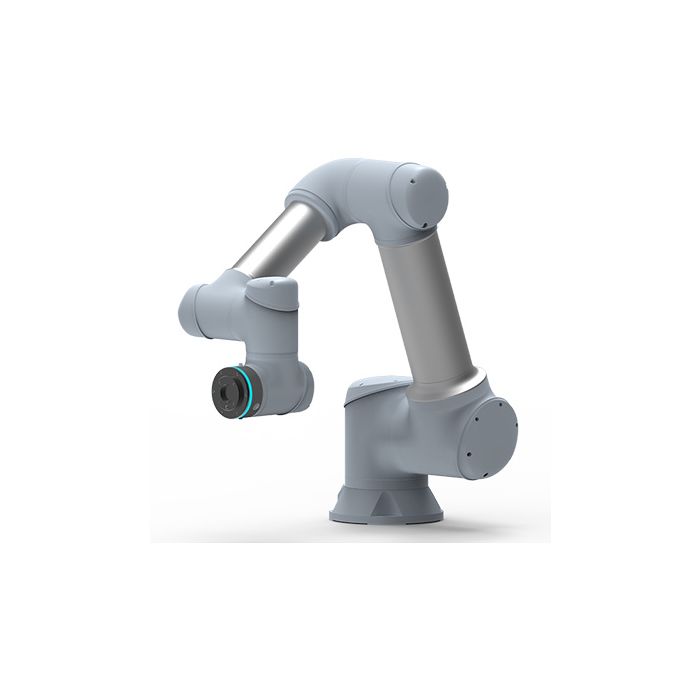
SIASUN Collaborative Robot (GCR16-960)
In stock
- BRAND:
- SIASUN
- PART #:
- GCR16-960
- ORIGIN:
- China
- AVAILABILITY:
- SUBJECT TO AVAILABILITY
- SKU:
- SIASUN-GCR16-960
SIASUN Collaborative Robot (GCR16-960)
Unlike traditional industrial robot arms that typically require rigid safety fencing, collaborative robots are intended to support risk-assessed collaborative operation modes (for example, speed-and-separation monitoring or power-and-force limiting), where the overall system—including tooling and the application—must be engineered to meet safety requirements. In practice, many deployments use cobots either in shared workspaces or in hybrid cells that add scanners, light curtains, or guarded zones depending on the process hazards and speeds involved.
Design and Features
Mechanical architecture
The GCR16-960 is a serial articulated, 6-axis robot arm with jointed links and integrated servo drives, enabling it to position and orient an end effector through a wide range of poses typical of collaborative arms. In SIASUN’s DUCO lineup, this class is generally optimized for compact installation footprints and relatively straightforward mounting (bench, pedestal, or mobile base), depending on the integrator’s design.
Human-friendly operation and deployment
Collaborative arms commonly emphasize:
-
Guided teaching / hand guiding (for quickly demonstrating paths)
-
Graphical programming and templates (to reduce programming time)
-
I/O and fieldbus integration for grippers, vision, and sensors
SIASUN’s DUCO cobot materials highlight ease-of-use characteristics typical of cobot platforms, with a focus on practical deployment in mixed human/automation environments.
Technology and Specifications
Core specifications (model-defining parameters)
From SIASUN DUCO GCR-series technical documentation, key published parameters for GCR16-960 include:
-
Rated payload: 16 kg
-
Reach: 960 mm
-
Degrees of freedom: 6
-
Repeatability: ±0.03 mm
-
Maximum TCP speed: 3.0 m/s
-
Ingress protection: IP54 (arm)
-
Robot mass: ~37 kg (net)
-
Typical power consumption: ~400 W (application dependent)
-
Operating environment: approximately -10 °C to 45 °C (typical cobot-rated ambient range)
Note: Exact values can vary by revision, controller configuration, cabling, and published regional datasheets; integrators typically confirm the latest datasheet before final cell design.
Collaborative safety context (standards-driven integration)
Collaborative operation is commonly engineered around guidance found in ISO/TS 15066 (often referenced alongside ISO 10218 requirements) covering collaborative methods such as power-and-force limiting and design/assessment considerations, including limiting forces, speeds, and contact pressures via risk assessment.
Because safety performance depends on the complete system (robot + tool + workpiece + motion + environment), integrators typically evaluate:
-
Tool shape and pinch/crush points
-
Speed/force settings and reduced-speed zones
-
Presence of process hazards (sharp tools, hot parts, lasers, etc.)
-
Safe stop functions and emergency stop architecture
Applications and Use Cases
Manufacturing and industrial operations
With 16 kg payload and near-1 m reach, the GCR16-960 is sized for many “mid-weight” collaborative tasks, including:
-
Machine tending: loading/unloading CNCs, presses, or test fixtures (often with guarded door interlocks or scanners)
-
Pick-and-place and kitting: handling bins, trays, and packaged components
-
Screwdriving and light assembly: using torque tools, compliance devices, and vision for alignment
-
Packaging and end-of-line: case handling, carton loading, and labeling support
-
Quality inspection: camera-based checks and gauging with structured lighting or 2D/3D vision
Flexible automation and short-run production
Cobots are frequently chosen where product mixes change often, because programming and redeployment can be faster than conventional robot cells. For many teams, a practical advantage is the ability to reuse one cobot platform across multiple stations (with quick-change tooling) rather than building a dedicated fenced cell per SKU.
Advantages / Benefits
Productivity and floor-space efficiency
A collaborative arm like the GCR16-960 can reduce manual handling for repetitive tasks while keeping cells relatively compact. The published ~37 kg robot mass also supports installations on lighter pedestals or mobile carts in some designs, provided stability and safety requirements are met.
Precision suitable for many assembly/handling tasks
A published repeatability of ±0.03 mm places the robot in a precision range often suitable for many fixture-based assembly and inspection applications, especially when combined with vision and part presentation strategies.
Lower integration friction compared with traditional robots (in the right use cases)
Collaborative platforms are often selected because they can simplify changeovers and enable safer interaction patterns—when the overall application is engineered to meet collaborative requirements. ISO/TS 15066 emphasizes that collaborative operation requires careful risk assessment and selection of risk reduction measures.
FAQ Section
What is the SIASUN GCR16-960 collaborative robot?
The GCR16-960 is a 6-axis collaborative robot arm from SIASUN’s DUCO cobot family, specified at 16 kg payload and 960 mm reach, intended for flexible automation tasks in manufacturing and industrial environments.
How does the GCR16-960 work?
Like most cobots, it uses servo-driven joints and closed-loop control to move an end effector through programmed paths. In collaborative applications, motion and interaction limits are set based on a risk assessment, often guided by collaborative robotics standards such as ISO/TS 15066.
Why is the GCR16-960 important?
It represents a mid-payload cobot option that can automate repetitive handling, assembly support, inspection, and machine tending while supporting faster changeovers and more flexible deployment than many traditional robot cells—especially in high-mix environments.
What are the benefits of the GCR16-960?
Common benefits include 16 kg payload capacity, ±0.03 mm repeatability, compact deployment options due to moderate robot mass, and suitability for a wide range of collaborative and semi-collaborative automation tasks—when properly integrated to safety requirements.
Summary
The SIASUN GCR16-960 is a medium-payload, 6-axis collaborative robot defined by its 16 kg payload and 960 mm reach, designed for flexible industrial automation tasks such as machine tending, handling, assembly support, and inspection. With published characteristics including ±0.03 mm repeatability, 3.0 m/s maximum TCP speed, and IP54 protection for the arm, it fits a broad set of factory use cases—provided the final application is engineered and validated to the relevant collaborative safety guidance and risk assessment practices.