SIASUN Customized Hybrid Robot
In stock
- BRAND:
- SIASUN
- PART #:
- CUSTOMIZED HYBRID ROBOT
- ORIGIN:
- China
- AVAILABILITY:
- SUBJECT TO AVAILABILITY
- SKU:
- SIASUN-Customized-Hybrid-Robot
SIASUN Customized Hybrid Robot
In SIASUN’s product framing, the “customized” aspect indicates that the robot is typically configured to match specific industrial processes—such as heavy-part handling, precision placement, or operations in environments where humans have limited access—rather than being a single fixed model with one universal specification. SIASUN positions these systems as a practical alternative when tasks require both material transport and robotic manipulation, especially in workflows that would otherwise require multiple pieces of automation equipment (e.g., an AGV plus a stationary robot cell).
Design and Features
Mobile base plus manipulator (“feet and hands” architecture)
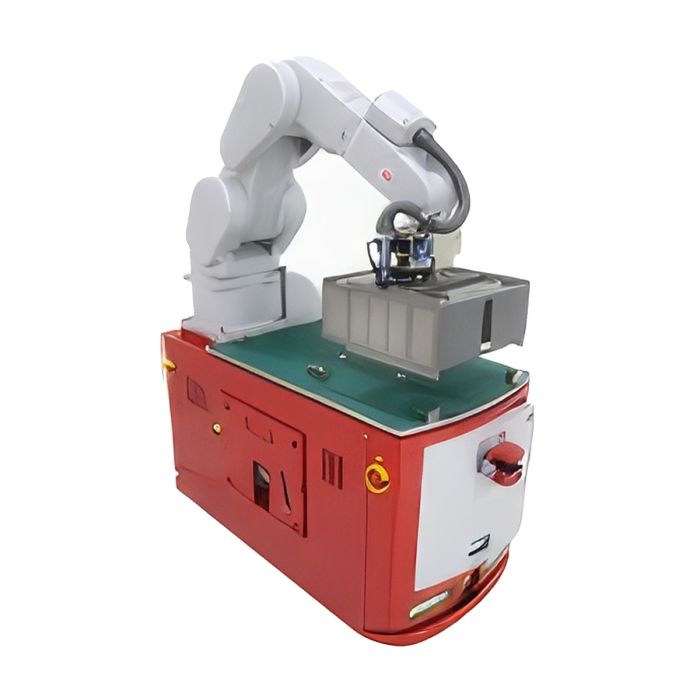
At the core of SIASUN’s hybrid robot concept is the integration of:
-
a mobile robot (base) responsible for navigation and transport, and
-
an industrial robot (arm) responsible for manipulation and task execution.
This architecture supports “mobile manipulation,” in which the robot can move to the work rather than requiring the work to be brought into a fixed automation cell.
Autonomous movement and automatic operation in one platform
SIASUN highlights that hybrid robots can realize autonomous movement and automatic operation at the same time. In real deployments, this typically means the system can:
-
receive a task (e.g., fetch and place a component),
-
navigate to a pickup zone,
-
manipulate a part or tool,
-
navigate to a destination workstation, and
-
complete an action such as placement, alignment, or assisted assembly.
Customization for process, tooling, and environment
SIASUN frames hybrid robots as customized composite robots, implying adaptation to:
-
required payload and reach,
-
end-of-arm tooling (grippers, vacuum, fastening tools, specialized fixtures),
-
navigation needs (facility layout, traffic rules, localization method), and
-
process constraints (clean areas, hazardous zones, limited human access).
Customization typically includes mechanical design (mounting and stability), control and safety logic, and integration with facility systems (e.g., task dispatching, barcode/ID scanning points, and interlocks).
System and fleet integration within SIASUN mobile robotics
SIASUN’s mobile robotics portfolio emphasizes end-to-end intralogistics solutions with standardized products and customized solutions. Hybrid robots fit into this portfolio when manipulation is required in addition to transport.
SIASUN also promotes the iMRS 2.0 platform as a mobile-robotics software framework intended to cover multiple sub-modules across deployment, operation, and analysis—relevant for orchestrating tasks, managing routes, and monitoring performance in larger deployments.
Technology and Specifications
What “hybrid” typically implies in SIASUN’s definition
SIASUN’s published definition of the hybrid robot category focuses on the functional combination (mobile base + industrial arm) rather than listing one standardized specification set.
As a result, specifications are usually determined by the chosen mobile base, arm type, and application needs.
Common specification parameters in hybrid mobile manipulation systems
While SIASUN’s product page does not provide a single universal datasheet for all customized hybrid robots, typical specification dimensions for this category include:
-
Mobile base
-
navigation method (site-dependent),
-
maximum speed and acceleration,
-
turning radius and aisle requirements,
-
battery capacity and charging approach,
-
payload capacity for carried items and robot-arm integration.
-
-
Manipulator
-
number of axes (DOF),
-
reach and workspace envelope,
-
payload and load/inertia limits at the tool center point,
-
repeatability and path stability (important for assembly and placement).
-
-
System
-
perception and sensing (e.g., obstacle detection, localization aids),
-
safety configuration and risk-reduction measures,
-
software interfaces for task dispatching and monitoring.
-
Operational safety and task feasibility
In practice, “replacing people” in hazardous or hard-to-access environments depends on the application’s risk assessment, tool hazards, and process controls. SIASUN frames hybrid robots as suitable for scenarios such as heavy assembly parts and hazardous or clean environments where personnel access is inconvenient.
Applications and Use Cases
Heavy-part transfer and assisted assembly
SIASUN explicitly notes that hybrid robots can replace people to complete the transfer and assembly of equipment or parts—particularly in cases involving heavy assembly parts.
A common pattern is: pick or secure a heavy component (or fixture) at a staging area, then deliver it to a workstation and perform alignment, positioning, or placement using the arm.
Clean environments and restricted-access areas
SIASUN describes hybrid robots as relevant where personnel have inconvenient access to clean environments.
In industrial terms, this can include controlled manufacturing zones where limiting human entry reduces contamination risk or improves process consistency.
Hazardous environments and risk reduction
SIASUN also positions composite/hybrid robots for hazardous environments, where using robotics can reduce exposure to risks such as heat, dust, chemical hazards, or heavy-handling incidents.
Integrated intralogistics plus manipulation workflows
Compared with transport-only mobile robots, a hybrid robot can complete a “last-meter” operation—such as presenting a part at a precise pose, loading/unloading a fixture, or manipulating a tool—rather than stopping at a drop zone and requiring human intervention.
Advantages / Benefits
Combines transport and manipulation in one system
The principal advantage of the hybrid approach is that one robot can both move and work, reducing the need for:
-
separate AGVs to deliver parts, and
-
fixed robot cells to manipulate parts in a single location.
This can be especially valuable in facilities where product mix changes frequently or where space constraints make fixed automation harder to justify.
Supports labor reduction for repetitive or difficult-access tasks
SIASUN’s description highlights scenarios where hybrid robots can “replace people” for transfer and assembly, particularly when tasks are heavy, repetitive, or poorly suited to direct human access.
Customization for specialized industrial workflows
Because SIASUN frames the product as “customized,” the system can be engineered for specific industries and workflows, including tailored tooling, custom load handling, and integration with production execution systems.
Potential for fleet-level management in larger deployments
Within SIASUN’s mobile robotics direction, platforms like iMRS 2.0 are positioned to support dispatching and lifecycle operation across mobile-robot deployments, which may include hybrid robots as part of a broader intralogistics and automation strategy.
FAQ Section (Featured Snippet–Optimized)
What is the SIASUN Customized Hybrid Robot?
The SIASUN Customized Hybrid Robot is a mobile manipulation system that combines a mobile robot base (“feet”) with an industrial robot arm (“hands”) to perform autonomous movement and automated operations.
How does the SIASUN Customized Hybrid Robot work?
It navigates autonomously to a location and then uses its robot arm to carry out tasks such as transfer, positioning, or assembly—enabling movement and manipulation in a single platform.
Why is the SIASUN Customized Hybrid Robot important?
It can automate workflows that require both transport and handling—especially for heavy parts, clean environments, or hazardous/restricted areas where human access is difficult or risky.
What are the benefits of the SIASUN Customized Hybrid Robot?
Key benefits include combining mobility and manipulation, reducing manual handling in difficult environments, and enabling flexible automation without relying solely on fixed robot cells.
Summary
The SIASUN Customized Hybrid Robot is a mobile manipulation concept that integrates a mobile robot base with an industrial robot arm, described by SIASUN as “feet and hands” working together to deliver autonomous movement and automatic operation in one system. Positioned for scenarios such as heavy-part transfer and assembly, restricted-access clean environments, and hazardous areas, the hybrid robot approach extends intralogistics beyond transport into manipulation and process execution. Because the category is typically delivered as a customized solution, specifications and pricing vary by payload, reach, navigation method, tooling, and integration scope.