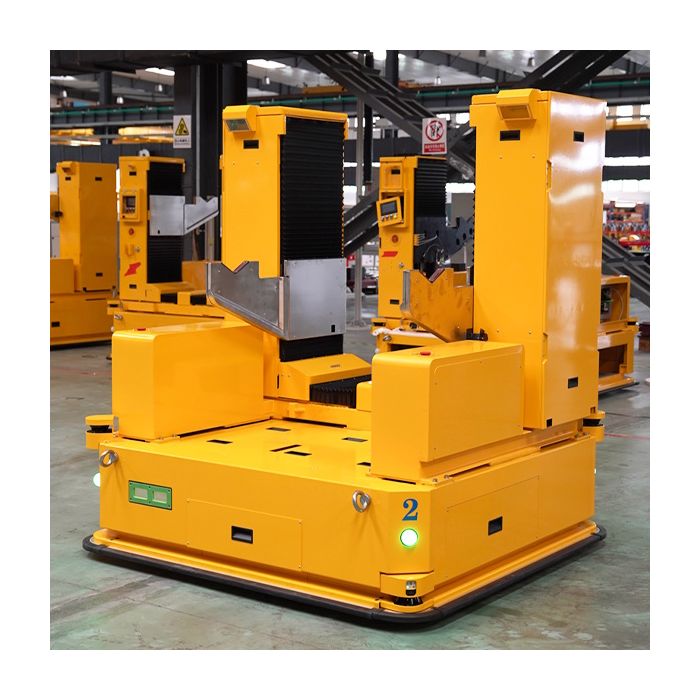
SIASUN AGV In New Energy Industry (AGV In New Energy Industry)
In stock
- BRAND:
- SIASUN
- PART #:
- AGV In New Energy Industry
- ORIGIN:
- China
- AVAILABILITY:
- SUBJECT TO AVAILABILITY
- SKU:
- SIASUN-AGV-In-New-Energy-Industry
SIASUN AGV In New Energy Industry (AGV In New Energy Industry)
In this context, “AGV” is used broadly to include specialized mobile robots (e.g., underdrive lifting units, fork-type or channel-type vehicles, heavy-duty transfer platforms, and composite/assembly robots) integrated with scheduling software and factory information systems to provide end-to-end, trackable material movement.
New energy factories tend to combine high throughput requirements, strict contamination controls, frequent product changeovers, and complex flows between machines. SIASUN positions its mobile robot deployments as part of “intelligent transformation” programs in which robots, dispatching, and digital systems jointly reduce manual transport, improve consistency, and enable scalable automation.
Design and Features
Mobile-robot families used in new energy plants
In practice, SIASUN’s “AGV in new energy” deployments are typically built from multiple robot types, selected by payload, docking style, and process constraints:
-
Underdrive lifting mobile robots: Designed to drive under racks or shelves and lift them for transport, often used for raw material movement and kitting workflows; the approach can improve space utilization versus traditional forklift aisles in some facility layouts.
-
V-block / channel / fork-type variants: Used for guided transport of battery cell materials and other standardized loads, often paired with centralized dispatching for stable line feeding.
-
Conveying / conveyor-type mobile robots: Mobile conveyors and roller-conveyor platforms that transfer items between stations without fixed conveyor infrastructure, enabling route changes as processes evolve.
-
Heavy-duty and customized AGVs: Platforms designed for high-weight handling and process-specific interfaces (fixtures, clamps, lift tables, or docking couplers), especially for upstream materials like foil rolls, mandrels, or bulky intermediates in battery manufacturing.
Integration-first architecture
A defining feature of industrial AGV projects is that vehicles rarely operate “standalone.” SIASUN references integration with MES/WMS/WCS—manufacturing execution, warehouse management, and warehouse control layers—so that tasks, traceability, and inventory states remain synchronized with physical movement.
Clean manufacturing considerations
Battery-related production can impose cleanliness and protection requirements that shape robot design choices. In a lithium battery copper-foil workflow example, SIASUN describes a solution that supports Class 10,000 cleanroom constraints and combines heavy-duty gantry robots, customized AGVs, and information systems across the production process.
Technology and Specifications
Because “SIASUN AGV in new energy” is a solution category rather than a single product model, specifications vary by robot type and project scope. Common technical elements include:
Navigation and guidance
Modern AGVs and mobile robots may use different guidance strategies (selected based on floor conditions, facility changes, and accuracy needs), such as:
-
Marker/reflector-based guidance (e.g., QR codes or reflectors)
-
Laser navigation (often used in mapped environments)
-
Natural-feature navigation (when supported by sensors and mapping)
-
Hybrid approaches, especially where different areas of a plant have different constraints
Docking, material interfaces, and automation depth
New energy workflows frequently require precise docking to machines, racks, buffers, or inspection/packaging cells. Solutions may include:
-
Lift mechanisms (underdrive or scissor-lift variants)
-
Fork/channel interfaces
-
Conveyor modules for automatic loading/unloading
-
Custom couplers for specialized carriers (e.g., rolls, mandrels, trays)
Digital orchestration and traceability
SIASUN highlights seamless integration with production management systems to optimize logistics efficiency and enable flexible routing and scaling (adding or removing robots as throughput changes).
Reliability and duty cycle
Industrial AGV deployments are commonly designed for continuous operations. In the copper-foil handling example, SIASUN describes standardized modules supporting 24/7 continuous operation, aimed at improving cycle time and capacity while enabling modular assembly and faster deployment.
Applications and Use Cases
Lithium battery manufacturing logistics
A widely cited use case is stable line feeding and internal logistics for battery cell production. SIASUN’s case narrative describes:
-
Underdrive lifting robots transporting raw materials by driving into shelves/racks
-
V-block double-lift robots distributing battery cell materials with dispatching for continuity
-
A single-arm axis robot performing load handling and precise docking to reduce product loss
Copper foil production and handling
In lithium battery copper-foil manufacturing, SIASUN describes an automated workflow spanning raw foil formation, baking, slitting, mandrel insertion/extraction, inspection, packaging, and boxing, combining gantry robots, customized AGVs, and MES/WMS/WCS connectivity in a cleanroom setting.
Flexible intralogistics without fixed conveyors
For facilities that want to avoid permanent conveyor lines (or need frequent layout changes), conveyor-type mobile robots can replace or complement fixed infrastructure. A third-party product listing describes advantages such as no need to lay rails, flexible route changes, and integration with production management systems for optimal handling efficiency.
Auxiliary assembly and hybrid workflows
In new energy plants, AGVs are often combined with “auxiliary assembly” or composite workflows—robots may deliver parts/kits to workcells, exchange fixtures, or position assemblies for downstream steps. This is typically implemented as a system design pattern: mobile platforms + standardized load carriers + dispatching + cell interfaces.
Advantages / Benefits
Benefits commonly targeted in SIASUN-style new energy AGV deployments include:
-
Higher logistics efficiency and space utilization: Underdrive lifting approaches can reduce reliance on traditional forklifts in certain material flows and improve flexibility in constrained areas.
-
Process stability and throughput support: Double-lift or specialized distribution robots are used to maintain timely, stable supply of materials to lines, improving continuity.
-
Reduced manual handling and damage risk: Mechanized docking and standardized carriers can reduce product loss and rework.
-
Scalability and reconfigurability: Mobile conveyors and AGVs can be re-routed as processes change, and fleet size can be adjusted with demand.
-
Digital traceability: Integration with MES/WMS/WCS supports track-and-trace, work-in-process visibility, and coordinated scheduling across production and logistics.
FAQ Section
What is SIASUN AGV in the New Energy Industry?
It is a category of SIASUN automated guided vehicles and mobile-robot systems used to automate material transport and in-process logistics in new energy manufacturing—especially lithium battery production—often integrated with factory software for traceability and scheduling.
How does SIASUN AGV in the New Energy Industry work?
A fleet of specialized mobile robots (e.g., underdrive lifting, fork-type, conveying platforms) receives tasks from dispatching software and moves materials between storage, buffers, and production equipment. Systems are commonly connected to MES/WMS/WCS layers so movements align with production orders and inventory states.
Why is SIASUN AGV automation important for new energy factories?
New energy factories often require high throughput, stable line feeding, and strict process control. Mobile robots can reduce manual transport, improve continuity of material supply, and support traceability—key requirements in battery manufacturing quality systems.
What are the benefits of SIASUN AGVs in lithium battery manufacturing?
Common benefits include improved logistics efficiency, better production continuity through reliable line feeding, reduced product loss via precise docking/handling, and stronger traceability through integration with digital systems.
Are SIASUN AGV systems compatible with cleanroom environments?
They can be designed for clean manufacturing needs. In one lithium battery copper-foil example, SIASUN describes an automated solution designed to meet Class 10,000 cleanroom requirements while integrating AGVs and information systems across the workflow.
Summary
SIASUN AGV deployments in the new energy industry represent an integrated approach to factory logistics automation—combining specialized mobile robots, robust docking and load-handling interfaces, and MES/WMS/WCS connectivity to support high-throughput, traceable, and adaptable material flow in battery and related manufacturing.