
Elephant Robotics Mercury Humanoid Robot B1 (4011300002)
In stock
- BRAND:
- ELEPHANT ROBOTICS
- PART #:
- 4011300002
- ORIGIN:
- China
- AVAILABILITY:
- SUBJECT TO AVAILABILITY
- SKU:
- Elephant-Robotics-4011300002
Elephant Robotics Mercury Humanoid Robot B1 (4011300002)
Elephant Robotics positions Mercury B1 as part of its Mercury humanoid robot series, designed to support education, scientific research, service, and exhibition/entertainment applications, particularly where bimanual manipulation and embodied intelligence prototyping are required.
At the hardware level, Mercury B1 integrates two A1 seven-axis robotic arms (14 axes) plus additional joints to reach a published total of 17 degrees of freedom (17DOF). It is specified with a 450 mm maximum working radius, 1 kg maximum payload, ±0.05 mm repeatability, and a 24 V electrical design, placing it in the category of lightweight, precision-oriented platforms for labs and classrooms rather than heavy industrial manipulation.
A defining characteristic of Mercury B1 is its emphasis on an integrated compute and software ecosystem for embodied-AI experimentation: the official specification page lists an NVIDIA-based controller with 67 TOPS computing performance, and Elephant Robotics states that the Mercury series supports popular robotics software environments and simulation platforms, including ROS, MoveIt, Gazebo, and MuJoCo.
Design and Features
Dual-arm semi-humanoid architecture
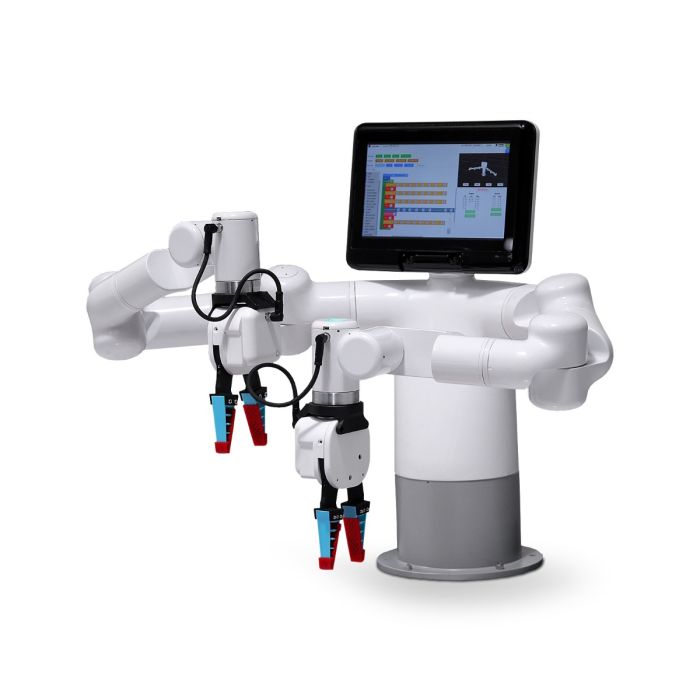
Mercury B1 is described by Elephant Robotics as a dual-arm semi-humanoid robot equipped with two A1 seven-axis robotic arms, supporting both single-arm independent operation and coordinated dual-arm operation.
This configuration enables research and teaching activities that are difficult to demonstrate with a single manipulator, such as two-hand object stabilization, handoffs, synchronized trajectories, and collision-aware bimanual planning.
9-inch screen “head” for interaction and control
Elephant Robotics specifies that Mercury B1’s head includes a 9-inch high-definition LCD touch screen with multi-point control and support for customizable expression display.
In practice, this screen can serve as a user interface for demos (status, mode selection, expressions) and as a convenient teaching feature for human–robot interaction scenarios where the robot needs to communicate intent or state.
Precision drivetrain and braking
The official specification page lists a harmonic reducer reduction mechanism and an electromagnetic friction plate joint brake.
Harmonic reducers are commonly used in compact robotics to improve positioning fidelity and torque density. Electromagnetic braking can support controlled holding behavior and safety-oriented stops (exact behavior depends on the control stack and application design).
Compact footprint and lightweight build
Elephant Robotics publishes Mercury B1’s size as 200 × 192.5 × 537 mm and net weight as 8 kg, supporting deployment on benches, pedestals, and lab stations without the facility requirements of larger industrial platforms.
This physical profile is frequently cited as a reason Mercury B1 is used for research demos, university labs, and exhibition prototypes where portability and setup speed matter.
Teleoperation and embodied-data collection orientation
The Mercury B1 product page highlights “Real-Time Exoskeleton Controller Manipulation,” framing the platform as suitable for teleoperation-style workflows (often used for demonstration control, data collection, and embodied learning pipelines).
Technology and Specifications
Core specifications (manufacturer-published)
Elephant Robotics’ official specification page for Mercury B1 lists the following key parameters:
-
Working voltage: 24 V
-
Degrees of freedom: 17 DOF
-
Maximum working radius: 450 mm
-
Maximum payload: 1 kg
-
Net weight: 8 kg
-
Repeatability: ±0.05 mm
-
Reduction mechanism: harmonic reducer
-
Joint brake: electromagnetic friction plate
Onboard computing (Jetson-class controller)
The official Mercury B1 specification page lists an NVIDIA-based controller featuring:
-
CPU: 6-core NVIDIA Carmel Arm v8.2 (64-bit) at 1.9 GHz
-
GPU: 512-core NVIDIA Volta architecture GPU with 64 Tensor Cores
-
Computing power: 67 TOPS
This compute profile is relevant to embodied intelligence workflows where perception (e.g., vision inference), planning, and control need to run locally with low latency.
Software ecosystem and simulation support
Elephant Robotics states that the Mercury series supports mainstream programming languages and popular simulation platforms, including ROS, MoveIt, Gazebo, and MuJoCo.
For ROS users, Elephant Robotics also maintains a public repository intended to control or simulate Mercury series robots in ROS, reinforcing the platform’s orientation toward academic and developer workflows.
Applications and Use Cases
Education and robotics training
Mercury B1 is commonly positioned for robot technology teaching where bimanual operation adds depth to curricula—e.g., coordinated motion planning, redundancy resolution across two arms, and safe collision-aware demonstrations. Reseller descriptions explicitly frame it as meeting needs across education and teaching scenarios.
Embodied intelligence and manipulation research
With 17DOF, integrated compute (67 TOPS), and compatibility with common robotics toolchains, Mercury B1 is suited to embodied AI projects such as:
-
learning bimanual manipulation policies
-
collecting teleoperated demonstration data (human-in-the-loop)
-
integrating perception + planning pipelines for pick, place, and tool-use research
Service and exhibition prototypes
The semi-humanoid form factor and screen-based head make Mercury B1 usable in controlled public demos such as:
-
interactive exhibitions and trade-show demonstrations
-
scripted “service” behaviors (greeting, pointing, presenting items)
-
research communication demos (showing autonomy modules safely in a bounded workspace)
Advantages / Benefits
Bimanual capability in a compact, lab-friendly system
Mercury B1’s core benefit is delivering a dual-arm, 17DOF platform at a size and weight that fits typical lab benches and demo pedestals (8 kg net weight).
Precision-oriented specification
The published ±0.05 mm repeatability supports repeatable demonstrations and research experiments where consistent trajectories reduce debugging time and improve reproducibility.
Strong onboard compute for perception-driven robotics
The listed NVIDIA-based controller and 67 TOPS compute provide headroom for on-device perception and embodied-AI experiments without relying on an external workstation for every pipeline component.
Broad software and simulation compatibility
Support for ROS/MoveIt and simulation environments such as Gazebo and MuJoCo is particularly valuable in education and R&D, where rapid iteration and reproducible testing are central requirements.
FAQ Section
What is the Elephant Robotics Mercury B1 (4011300002)?
The Mercury B1 is a dual-arm semi-humanoid robot from Elephant Robotics, commonly sold under part number 4011300002, featuring 17 degrees of freedom and a 9-inch touch-screen head.
How does Mercury B1 work?
Mercury B1 combines two seven-axis arms for independent or coordinated manipulation, driven through harmonic reducers and managed by an NVIDIA-based controller listed at 67 TOPS, enabling perception-driven and AI-assisted robotics workflows.
Why is Mercury B1 important?
It provides a lab-friendly platform for bimanual manipulation and embodied intelligence research, pairing dual-arm capability with simulation and software support (ROS/MoveIt/Gazebo/MuJoCo) that accelerates education and prototyping.
What are the benefits of Mercury B1?
Key benefits include 17DOF dual-arm operation, ±0.05 mm repeatability, 1 kg payload, 450 mm working radius, a 9-inch touchscreen for interaction, and strong onboard computing for embodied AI experimentation.
Summary
Elephant Robotics Mercury Humanoid Robot B1 (4011300002) is a compact dual-arm semi-humanoid platform built around two seven-axis arms (17DOF total), a 9-inch interactive screen, and an NVIDIA-based onboard controller rated at 67 TOPS. With published lab-friendly specs—1 kg payload, 450 mm reach, and ±0.05 mm repeatability—and support for widely used robotics ecosystems such as ROS/MoveIt and common simulators, Mercury B1 is positioned as a practical system for education, bimanual manipulation research, and embodied intelligence prototyping.