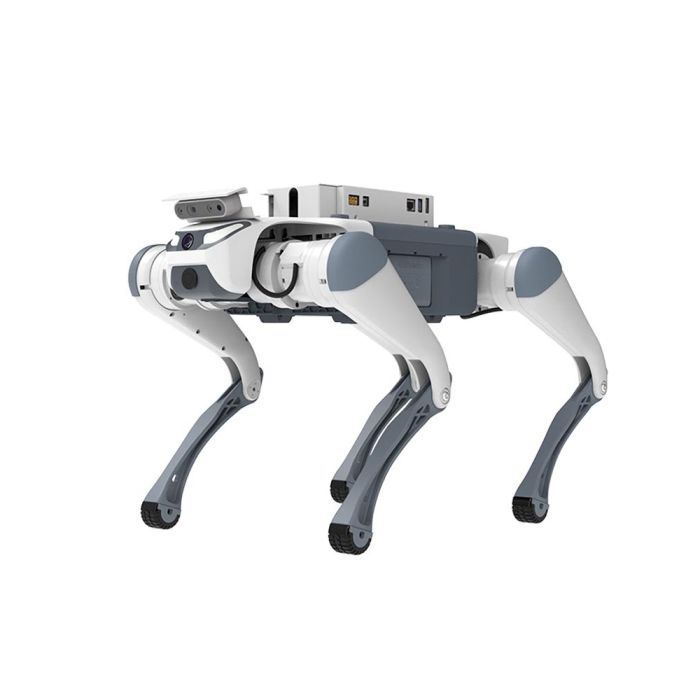
Deep Robotics Lite3 Pro Quadruped Robot Dog
In stock
- BRAND:
- DEEP ROBOTICS
- PART #:
- Lite3 Venture
- ORIGIN:
- China
- AVAILABILITY:
- ALLOW 2-4 WEEKS FOR DELIVERY
- SKU:
- Deep-Robotics-Lite3-Pro
Deep Robotics Lite3 Pro Quadruped Robot Dog
Deep Robotics Lite3 Pro Quadruped Robot Dog
Within the Lite3 family (commonly presented as Basic, Venture, Pro, and LiDAR variants), the Pro model is positioned as a development-ready platform for perception and autonomy prototyping, adding enhanced perception functions and a richer interface set while preserving the Lite3 series’ compact, portable form factor.
Deep Robotics’ official Lite3 documentation frames the series as a high-performance quadruped designed for reinforcement learning experiments and research workflows, with open SDK/API access and support for ROS-based development.
Design and Features
Compact research-grade quadruped design
Deep Robotics lists the Lite3 Pro’s standing dimensions as 610 × 370 × 450 mm and its weight as 12.9 kg, placing it in a lightweight class suitable for lab transport, classroom use, and controlled field trials.
Enhanced perception features for safer, more autonomous behavior
The Pro configuration adds perception capabilities beyond entry-level Lite3 variants. In Deep Robotics’ official specifications, Lite3 Pro includes:
-
Front/rear obstacle stop
-
Visual following
-
Forward obstacle avoidance
Developer-oriented connectivity and expansion interfaces
Lite3 Pro is specified with an interface set intended to simplify integration of sensors, payload computers, and test instrumentation. The official Pro configuration lists USB 3.0, HDMI, Ethernet, plus external power input (24V/12V/5V) and a power connector.
Secondary development ecosystem
Deep Robotics explicitly promotes the Lite3 line for secondary development, stating it provides models, a motion control SDK and APIs, and perception development interfaces with sample code—a key difference between research platforms and consumer-focused robot products.
Technology and Specifications
Physical and mobility specifications (official)
Deep Robotics publishes the following Lite3 Pro specifications:
-
Standing dimensions (L × W × H): 610 × 370 × 450 mm
-
Weight: 12.9 kg
-
Payload capacity: 4 kg
-
Maximum slope: 40°
-
Obstacle clearance: 18 cm
-
Continuous operation: 1.5–2 hours
-
Maximum range: 3.4 km
Deep Robotics also notes that listed parameters are laboratory data and may differ in real environments.
Compute architecture for motion and perception
In its Lite3 FAQs, Deep Robotics describes a split compute approach: an RK3588 ARM-architecture processor for the motion host and an NVIDIA Jetson Xavier NX for the perception host in the Pro/LiDAR versions. The company states this combination supports real-time control and AI perception for workflows such as SLAM, autonomous navigation, and visual recognition.
Operating system and ROS support
Deep Robotics states Lite3 supports Ubuntu 20.04 and is compatible with ROS1 (Noetic) and ROS2 (Foxy), with built-in scripts to switch between ROS1 and ROS2 depending on research requirements.
Perception development and sensor ecosystem (platform-level)
Deep Robotics’ Lite3 FAQ describes Lite3 integrating an Intel RealSense D435i depth camera and optional Livox or Leishen LiDAR modules for mapping and localization workflows in LiDAR-based SLAM and navigation examples.
While Pro is not the same as the LiDAR configuration, this platform-level tooling and compute stack is relevant to Pro users building perception pipelines and obstacle avoidance research prototypes.
Reinforcement learning workflow considerations
Deep Robotics’ Lite3 technical content emphasizes reinforcement-learning-based workflows, including sim-to-real deployment. It also notes that the onboard Jetson Xavier NX is typically used for inference rather than full RL training, which is generally performed on a desktop GPU and then deployed to the robot.
Applications and Use Cases
Academic research in legged locomotion and control
Lite3 Pro is commonly used as a physical platform for studying legged robotics topics such as gait stability, disturbance rejection, and control policy evaluation. Deep Robotics highlights joint-level data access (torque, velocity, position feedback) via the Motion SDK for tuning and research.
Perception development and obstacle-aware navigation prototypes
Because Pro adds forward obstacle avoidance and includes expansion interfaces (USB/HDMI/Ethernet and external power), it is often used for practical perception projects such as:
-
obstacle-aware walking experiments,
-
visual tracking and following demonstrations,
-
sensor fusion and mapping prototyping (often with external sensors or lab instrumentation).
Robotics education beyond entry-level curricula
Universities and training programs often segment platforms by complexity. Lite3 Pro fits advanced coursework where students implement perception and autonomy modules on ROS, test policies in real environments, and learn system integration practices with real hardware constraints (power budgets, latency, and sensor calibration).
R&D validation and demonstration
The Lite3 Pro’s portability (12.9 kg) and published terrain specs (40° slope, 18 cm obstacle clearance) support controlled outdoor pilots and demonstration environments where wheeled robots struggle with uneven ground, curbs, or stairs.
Advantages / Benefits
A “middle autonomy” configuration for fast iteration
Lite3 Pro is often selected when teams want more than basic following/stop behaviors but do not require full LiDAR navigation packages. Its official feature set includes forward obstacle avoidance without requiring the heavier LiDAR configuration.
Research-ready interfaces for real sensor and compute payloads
USB 3.0, HDMI, Ethernet, and multi-voltage external power input reduce friction in prototype builds (camera bars, radios, embedded compute, data loggers). This connectivity supports rapid, repeatable experimentation—especially in academic labs.
Platform alignment with ROS and embodied AI workflows
Deep Robotics’ stated support for Ubuntu 20.04 and ROS1/ROS2, plus the described Pro compute architecture (RK3588 + Jetson Xavier NX), makes Lite3 Pro a common choice for embodied AI pipelines where perception inference runs onboard while training and dataset work happens offboard.
Published performance envelope for planning experiments
Manufacturer specifications—payload, slope, obstacle clearance, and runtime—provide a practical baseline for lab planning (battery scheduling, payload limits, and test-site selection), with the caveat that real-world performance varies from lab conditions.
FAQ Section
What is the Deep Robotics Lite3 Pro Quadruped Robot Dog?
The Lite3 Pro is an advanced Lite3 configuration from Deep Robotics designed for robotics education and R&D, with forward obstacle avoidance, developer interfaces, and a compact 12.9 kg form factor.
How does the Lite3 Pro work?
Lite3 Pro combines quadruped locomotion with onboard perception features (obstacle stop, visual following, forward obstacle avoidance) and a development stack that supports secondary development via SDK/APIs and ROS-based workflows.
Why is the Lite3 Pro important?
It provides a practical legged research platform that bridges education and real-world prototyping—offering published mobility specs plus onboard compute and interfaces suitable for perception and autonomy experiments on ROS.
What are the benefits of the Lite3 Pro?
Deep Robotics lists benefits including a compact chassis (610 × 370 × 450 mm), 4 kg payload capacity, 40° slope capability, 18 cm obstacle clearance, 1.5–2 hours runtime, and interfaces such as USB 3.0/HDMI/Ethernet plus external power input.
Summary
The Deep Robotics Lite3 Pro is a compact, developer-oriented quadruped robot dog designed for advanced robotics education and research, especially projects that require perception development and obstacle-aware mobility without a full LiDAR navigation configuration. Official specifications highlight a 12.9 kg platform with 4 kg payload, 40° slope capability, 18 cm obstacle clearance, and 1.5–2 hours of runtime, plus a development-friendly interface set (USB 3.0, HDMI, Ethernet, external power). Supported by ROS1/ROS2 compatibility and a Pro-class compute architecture described by Deep Robotics, Lite3 Pro is widely positioned as a practical hardware base for embodied AI prototyping, reinforcement-learning inference deployments, and real-world locomotion validation.
Specifications
General
Physical
Performance
Software
What's included
Downloads
Related Products
Out of stock