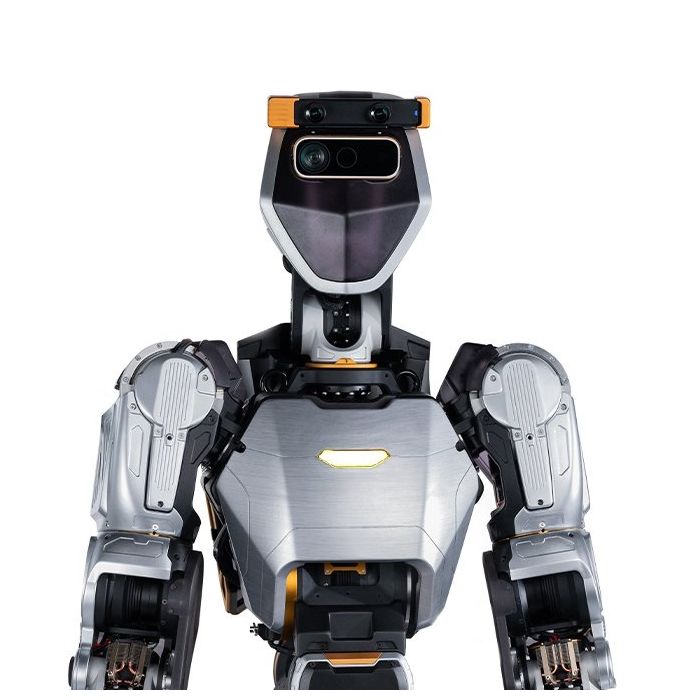
Sanctuary AI Phoenix Humanoid Robot
In stock
- ماركة:
- SANCTUARY AI
- نموذج:
- PHOENIX
- ORIGIN:
- كندا
- AVAILABILITY:
- SUBJECT TO AVAILABILITY
- SKU:
- Sanctuary-AI-Phoenix
Sanctuary AI Phoenix Humanoid Robot
The Sanctuary AI Phoenix Humanoid Robot is a general-purpose bipedal humanoid developed by Sanctuary AI, a robotics and artificial intelligence company based in Vancouver, Canada. Third-party listings describe a human-scale machine of roughly 170 cm and about 70 kg with highly dexterous, haptic-equipped hands, positioned for work in human-centric environments such as retail back rooms, warehouses, and light manufacturing. Phoenix is best understood as an emerging-technology platform: reported deployments are pilot programs, and detailed specifications should be confirmed directly at quotation.
Background
Sanctuary AI and the Carbon Control System
Sanctuary AI (Sanctuary Cognitive Systems Corporation) was founded with an unusually explicit mission for a robotics company: to create embodied artificial general intelligence, with humanoid robots serving as the physical vehicle for that goal. Phoenix is the company's flagship expression of this strategy. Rather than optimizing first for sprinting, jumping, or acrobatics, Sanctuary AI concentrated on cognition and manipulation — the abilities that determine whether a robot can actually complete economically useful tasks in spaces designed for people. The centerpiece is Carbon, the company's proprietary AI control system, described as a cognitive architecture that integrates modern AI technologies to understand instructions given in natural language, reason about goals, and drive the robot's body to carry tasks out. A notable element of the approach is the use of human teleoperation as a training mechanism: skilled operators demonstrate tasks through the robot, and those demonstrations become training data from which the AI system learns, gradually expanding the set of tasks Phoenix can perform with increasing autonomy. Third-party reporting indicates the company has raised over 140 million dollars to pursue this roadmap.
From Unveiling to Pilot Deployments
Phoenix was publicly unveiled in May 2023 and has since progressed through multiple hardware generations, with later versions described by industry trackers as a carbon-fiber-bodied, electrically actuated platform in pilot status. According to third-party industry sources, Phoenix has been placed in pilot programs with commercial partners — including reported work connected to major retail and automotive-manufacturing organizations — where it performs tasks such as stocking, picking and packing, and general material handling. These deployments are significant because they represent paid, real-environment trials rather than laboratory demonstrations, but they should still be read as pilots: the platform's readiness, task repertoire, and commercial availability continue to evolve, and published capability assessments vary between independent trackers. Buyers evaluating Phoenix are therefore evaluating both a machine and a fast-moving development program.
Technical Specifications
| Attribute | Reported value |
|---|---|
| Type | General-purpose bipedal humanoid robot |
| Manufacturer | Sanctuary AI (Sanctuary Cognitive Systems Corporation), Vancouver, Canada |
| Unveiled | May 2023 |
| Height | Approx. 170 cm (5'7") |
| Weight | Approx. 70 kg |
| Locomotion | Bipedal walking, electric actuation |
| Reported walking speed | Approx. 3–5 km/h (sources differ) |
| Hands | Highly dexterous multi-degree-of-freedom hands with proprietary haptic (touch) feedback |
| Reported payload/strength | Around 25 kg per third-party listings |
| Control system | Carbon proprietary AI control system; natural-language task understanding |
| Training method | Human teleoperation demonstrations feeding AI learning |
| Status | Pilot deployments; not a mass-market production product |
All figures above are drawn from third-party industry listings rather than a manufacturer datasheet reviewed for this page; published sources differ on several values, including speed and total degrees of freedom, so every specification should be treated as indicative and confirmed with the manufacturer or during quotation for the specific generation offered.
What makes Phoenix different from other humanoid robots?
Most humanoid programs lead with locomotion highlights; Sanctuary AI leads with cognition and touch. Phoenix's differentiation rests on three pillars. Third, the teleoperation-to-autonomy pipeline: by having human pilots perform real work through the robot and using those sessions as training data, Sanctuary AI can deploy Phoenix into genuine commercial environments early while progressively increasing autonomous task coverage. The result is a humanoid whose value proposition is task completion in human spaces rather than athletic demonstration.
How is Phoenix trained to do useful work?
Phoenix's development model treats every supervised work session as a lesson. Human operators teleoperate the robot through real tasks — moving goods, stocking, packing — and the Carbon system learns from these demonstrations, building toward autonomous execution of the same tasks. This approach has practical implications for prospective adopters: early engagements typically resemble structured pilot programs, where the robot's task set is defined together with the vendor, performance is measured in the customer's actual environment, and autonomy expands over the engagement rather than arriving complete on day one. Organizations should therefore plan for collaboration — site assessment, task selection, safety review, and integration with existing workflows — rather than a plug-and-play appliance purchase.
Who is the Sanctuary AI Phoenix Humanoid Robot for?
Phoenix is aimed at organizations facing persistent labor shortages in repetitive, physical, human-environment work, and at institutions that want early access to embodied-AI technology. Realistic candidates include retail and logistics operators interested in piloting humanoid labor for stocking, picking, and packing; manufacturers exploring flexible automation for light assembly and material handling where fixed automation is impractical; and research institutions, universities, and innovation labs studying embodied AI, dexterous manipulation, and human-robot collaboration. Given its pilot-stage status, Phoenix suits early adopters comfortable with a structured deployment program and evolving capabilities, rather than buyers needing a fully mature, high-volume production robot today.
What is the Sanctuary AI Phoenix Humanoid Robot used for?
- Retail back-of-store operations — reported pilot work includes stocking and merchandise handling tasks in retail environments.
- Warehouse picking and packing — order-fulfillment style tasks that exploit the robot's dexterous, haptic-equipped hands.
- General material handling — moving, sorting, and staging goods in human-centric facilities without fixed automation infrastructure.
- Light manufacturing support — flexible assistance around production lines where tasks change too often for dedicated machinery.
- Embodied-AI research and development — serving as a platform for studying natural-language robot control, dexterity, and teleoperation-based learning.
- Workforce-automation piloting — structured trials that let organizations measure humanoid labor against real tasks before scaling.
Pricing and Availability
Phoenix is an advanced, pilot-stage humanoid platform, and commercial terms depend on the generation offered, the engagement model, task scope, support, and training arrangements. No standard list price is published on this page, and purchase details are confirmed through quotation. To explore acquiring Phoenix or arranging a pilot engagement, submit a request for quotation through this page; a specialist will confirm current availability, configuration options, deployment requirements, and pricing for your use case.
Frequently Asked Questions
How tall and heavy is the Sanctuary AI Phoenix?
Third-party listings describe Phoenix as approximately 170 cm (5'7") tall and around 70 kg — deliberately human-scale so it can operate in spaces built for people.
What is the Carbon AI control system?
Carbon is Sanctuary AI's proprietary cognitive control software. It is designed to understand natural-language instructions, reason about tasks, and drive the robot's body to complete them, learning in part from human teleoperation demonstrations.
How dexterous are Phoenix's hands?
The hands are the platform's signature feature: multi-degree-of-freedom designs approaching human-like dexterity, equipped with proprietary haptic technology that gives the robot a sense of touch for fine manipulation.
Is Phoenix commercially deployed today?
Third-party sources report pilot deployments with commercial partners, including retail-related task work. These are structured pilots rather than mass-market rollouts, and availability is confirmed case by case.
Can Phoenix work safely alongside people?
Phoenix is designed for human-centric environments and collaborative operation. Actual deployment safety always depends on professional site assessment, defined operating protocols, and the regulatory context of the installation, which are addressed during the engagement.
How fast can Phoenix move and how much can it carry?
Published third-party figures suggest walking speeds of roughly 3–5 km/h and strength around 25 kg, but sources differ; exact figures for the offered generation should be confirmed at quotation.
Where can I buy the Sanctuary AI Phoenix Humanoid Robot and what does it cost?
Phoenix can be requested through this page. Because engagements are configured individually and the platform is pilot-stage, pricing is provided by quotation — submit a request and a specialist will confirm availability, terms, and cost.
Summary
The Sanctuary AI Phoenix Humanoid Robot represents one of the most cognition-centric approaches in modern humanoid robotics: a human-scale bipedal platform whose defining assets are the Carbon AI control system, exceptionally dexterous haptic hands, and a teleoperation-to-autonomy training pipeline already exercised in reported commercial pilots. For retailers, logistics operators, manufacturers, and research institutions weighing early adoption of humanoid labor, Phoenix offers a serious, well-funded program from a Canadian pioneer — with the understanding that specifications vary between published sources and engagements are structured pilots confirmed through quotation. For evaluating whether Phoenix fits your operation, this page is the starting point.