
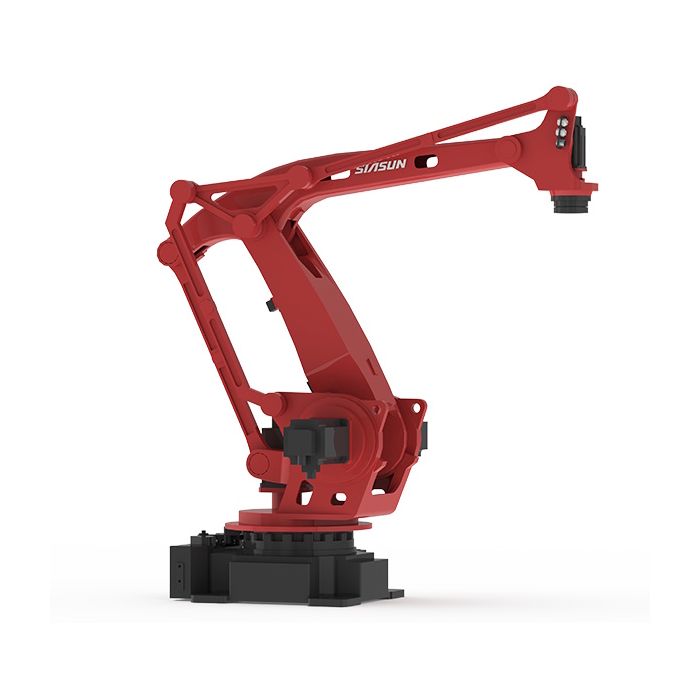
SIASUN Industrial Palletizing Robot Arm with 2500mm Reach, 120kg Max Payload, 4 DOFs (SP120A-120/2.50)
In stock
- HANDELSMERK:
- SIASUN
- DEEL #:
- SP120A-120/2.50
- ORIGIN:
- Sjina
- AVAILABILITY:
- SUBJECT TO AVAILABILITY
- SKU:
- SIASUN-SP120A-120/2.50
SIASUN Industrial Palletizing Robot Arm with 2500mm Reach, 120kg Max Payload, 4 DOFs (SP120A-120/2.50)
The SIASUN Industrial Palletizing Robot Arm with 2500mm Reach, 120kg Max Payload, 4 DOFs (SP120A-120/2.50) is a newly upgraded, dedicated palletizing robot engineered for one job and engineered for it thoroughly: moving and stacking packaged goods quickly, precisely, and without fatigue. With a 120 kg maximum payload, a 2500 mm reach, and a four-axis architecture purpose-built for palletizing motion, the SP120A-120/2.50 handles bags, boxes, and cases across an expansive operating area while occupying a compact footprint. It ships with a dedicated palletizing software package that lets operators define pallet types and production parameters intuitively, making it a practical fit for flexible production lines in the food, medical, electronics, and general manufacturing sectors.
Background
SIASUN and Dedicated Palletizing Robots
SIASUN is one of China's most prominent industrial robotics manufacturers, with a broad catalog spanning industrial arms, mobile robots, and factory automation systems. Within that catalog, the SP series represents the company's dedicated palletizing line — machines optimized specifically for end-of-line handling rather than adapted from general-purpose six-axis designs. Dedicated palletizers use a four-degree-of-freedom architecture because palletizing rarely requires full six-axis wrist articulation: loads travel from pick point to pallet in predictable arcs, with the gripper kept level throughout. Removing unneeded axes yields real advantages — higher sustainable speeds, simpler kinematics, greater rigidity under heavy loads, easier programming, and lower maintenance complexity. The SP120A-120/2.50 applies this philosophy in the mid-heavy payload class, pairing a 120 kg capacity with an elongated 2500 mm arm so a single robot can serve wide pick-and-place layouts and multiple pallet stations.
The Shift From Manual Stacking to Robotic Palletizing
Palletizing is among the most physically punishing recurring jobs in manufacturing and logistics: repetitive lifting of heavy sacks and cases drives injuries, fatigue-related errors, and chronic staffing difficulty. It is also a natural robotics application, because the task is structured, repetitive, and continuous across shifts. Modern dedicated palletizers such as the SP120A-120/2.50 address both sides of the equation. For workers, the robot removes heavy repetitive lifting from the job entirely. For operations, it delivers consistent stacking quality, stable cycle times across an entire shift, and pallet patterns executed identically every time — which improves load stability in transport and reduces product damage. The SP120A-120/2.50's upgrade emphasis on a lightweight design and compact, refined mechanical structure reflects the practical priorities of this market: fitting into existing line layouts, reducing footprint, and expanding the range of scenarios where a palletizing robot is viable.
Technical Specifications
| Attribute | Value |
|---|---|
| Model | SP120A-120/2.50 |
| Manufacturer | SIASUN |
| Type | Dedicated industrial palletizing robot arm |
| Degrees of freedom | 4 axes |
| Maximum payload | 120 kg |
| Reach | 2500 mm |
| Handled goods | Bags, boxes, cases, and similar packaging materials |
| Positioning | High-precision positioning maintained during high-speed operation |
| Software | Dedicated palletizing software package with intuitive pallet-type and production-parameter setup |
| Construction | High-strength materials, lightweight design, compact optimized mechanical structure |
| Typical operations | Palletizing, depalletizing, handling, packing, packaging, sorting |
| Target industries | Food, medical, electronics, and other manufacturing and logistics sectors |
The figures above reflect the manufacturer-provided product description for this model; complete engineering data such as repeatability, axis speeds, mounting requirements, and controller details are configuration-specific and should be confirmed against the official datasheet during quotation.
What makes the SP120A-120/2.50 efficient at palletizing?
Three design decisions drive this machine's productivity. First, the four-axis architecture: by dedicating the kinematics to palletizing motion, the robot combines high speed with stability, achieving precise positioning while sustaining the aggressive cycle rates that end-of-line work demands. SIASUN describes the model's operating space and power output as leading indicators in its class. Second, the elongated arm: the 2500 mm reach creates an expansive work envelope, allowing one robot to service multiple infeed conveyors and pallet positions, adapt to diverse pallet layouts, and maximize floor-space utilization in warehouses and production halls.
How easy is the SP120A-120/2.50 to set up and program?
Ease of deployment is one of this model's headline attributes. The robot is described as easy to install and operate, and it ships with a dedicated palletizing software package built around the way palletizing actually gets configured on a factory floor. This matters most on flexible production lines, where product sizes, case counts, and pallet patterns change frequently: the SP120A-120/2.50 is explicitly positioned to adapt to such requirements while maintaining consistent work quality. For integrators, the combination of a dedicated software package and a standard four-axis palletizing architecture keeps commissioning predictable compared with adapting a general-purpose robot to the same task.
Who is the SIASUN SP120A-120/2.50 for?
This robot suits manufacturers, co-packers, and logistics operations that move substantial volumes of bagged, boxed, or cased product and want to automate end-of-line handling. Typical adopters include food and beverage plants stacking sacks and cartons; pharmaceutical and medical-product manufacturers requiring consistent, hygienic, low-touch handling; electronics producers palletizing finished-goods cases; and warehouse or distribution operations automating high-throughput stacking and destacking. It fits both large automated facilities seeking a proven palletizing cell and mid-size plants making their first move from manual stacking, particularly where heavy loads up to 120 kg or wide multi-pallet layouts rule out smaller arms.
What is the SIASUN SP120A-120/2.50 used for?
- Palletizing — stacking bags, boxes, and cases from production or conveyor lines onto pallets in operator-defined patterns.
- Depalletizing — breaking down incoming pallets and feeding goods into production or sorting processes.
- Heavy material handling — transferring loads up to 120 kg between stations across the 2500 mm work envelope.
- Packing and packaging support — placing products into cases or consolidating packaged goods at end-of-line stations.
- Sorting operations — routing cased or bagged goods to different pallet positions or lanes by product or destination.
- Labor relief on strenuous lines — replacing repetitive heavy lifting in food, medical, electronics, and similar industries to reduce labor intensity and raise production efficiency.
Pricing and Availability
The SP120A-120/2.50 is supplied as an industrial capital good, and final pricing depends on configuration, gripper/end-of-arm tooling, software options, delivery destination, and integration scope. No list price is published on this page, and purchase details — including current availability — are confirmed through quotation. To receive a tailored offer with the official datasheet, recommended cell configuration, lead-time information, and commercial terms, submit a request for quotation through this page and a specialist will respond promptly.
Frequently Asked Questions
What payload and reach does the SP120A-120/2.50 offer?
The robot handles loads up to 120 kg at a reach of 2500 mm, giving it an expansive operating area suited to wide palletizing layouts and heavy packaged goods.
Why does a palletizing robot have only 4 axes?
Palletizing keeps loads level along predictable paths, so full six-axis articulation is unnecessary. A four-axis design delivers higher speed, greater rigidity under load, simpler programming, and lower maintenance for this task class.
What kinds of products can it stack?
The SP120A-120/2.50 is designed for all common packaging formats, including bags and sacks, boxes, and cases. Suitability for a specific product and gripper is confirmed during quotation.
How is the robot programmed?
It ships with a dedicated palletizing software package: operators set parameters such as pallet type and production efficiency through an intuitive interface rather than programming motions point by point, which greatly simplifies setup and changeovers.
Which industries typically use this robot?
SIASUN positions the model for food, medical, and electronics manufacturing among others — anywhere heavy, repetitive handling, palletizing, depalletizing, packing, or sorting work needs automation.
Is it suitable for high-speed production lines?
Yes. The design combines high speed with stability and precise positioning, and the manufacturer highlights its operating space and power output as leading performance indicators, making it appropriate for demanding automated lines.
Where can I buy the SIASUN SP120A-120/2.50 and what does it cost?
The robot can be requested directly through this page. Pricing depends on configuration and tooling, so submit a request for quotation and a specialist will confirm availability, terms, and cost for your project.
Summary
The SIASUN SP120A-120/2.50 is a focused answer to one of industry's most persistent handling problems: a dedicated four-axis palletizing robot with a 120 kg payload, 2500 mm reach, and a compact, upgraded mechanical structure that fits real factory layouts. Its dedicated palletizing software turns pattern setup into parameter entry rather than programming, while high-strength construction promises long service life, wear resistance, and low maintenance cost. For food, medical, electronics, and logistics operations ready to replace heavy manual stacking with consistent robotic throughput, this page is the starting point.